
Composer library · 1784 –1849
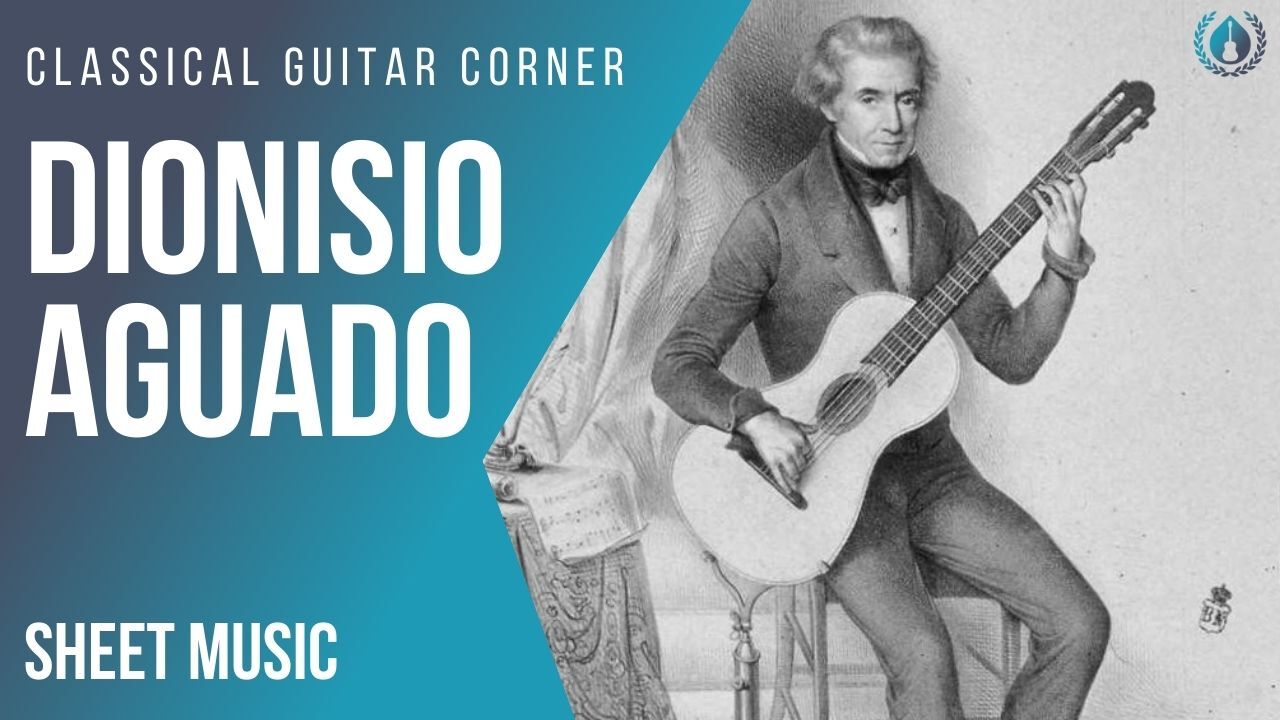
Dionisio Aguado
Sheet music, performances, and resources for classical guitar.
Explore the archive and follow the links to recordings and further learning.
Download · Listen · Learn
Dionisio Aguado sheet music & resources
Download individual PDFs without signing up. Archive editions vary in print quality and fingering; some contain complete sets of pieces.
19 resources · 18 PDFs
3 Rondos, Op. 2
Archive score · 17 pages · 2.0 MB
4 Valses Faciles, Op. 7
Archive score · 6 pages · 437 KB
6 Menuets et 6 Valses Op. 12
Archive score · 12 pages · 1.3 MB
6 Petite Pieces, Op. 4
Archive score · 7 pages · 701 KB
6 Valses
Archive score · 3 pages · 254 KB
8 Petites Pieces, Op. 3
Archive score · 7 pages · 744 KB
10 Contredanses, Op. 11b
Archive score · 11 pages · 990 KB
10 Petite Pieces, Op. 14
Archive score · 11 pages · 757 KB
12 Valses Op. 1
Archive score · 5 pages · 312 KB
Contredanses et Valses, Op. 8
Archive score · 10 pages · 674 KB
Contredanses Menuets et Valses Op. 13a
Archive score · 19 pages · 1.7 MB
Dionisio Aguado, Introduction and Rondo No.2, Op.2 (Drew Henderson, guitar)
Video resource
Exercices Faciles, Op. 10
Archive score · 10 pages · 855 KB
Le Fandango Varié, Op. 16
Archive score · 11 pages · 437 KB
Les Favorites: 8 Contredanses, Op. 11
Archive score · 12 pages · 927 KB
Menuet Affandango, Op. 15
Archive score · 9 pages · 951 KB
Méthode — edition 1
Archive score · 44 pages · 3.7 MB
Morceaux Agréables, Op. 13
Archive score · 11 pages · 806 KB
Nuevo Método
Archive score · 131 pages · 11.6 MB
No matching resources. Try a shorter name or choose “All resources”.
PDFs from CGC’s existing composer archive. Open the backup collection in Google Drive.
Hear the music
Dionisio Aguado, Introduction and Rondo No.2, Op.2 (Drew Henderson, guitar)
Listen to this selection, then return to the catalogue to explore the available scores and resources.
Back to the resources
The composer behind the music
Dionisio Aguado: biography
Dionisio Aguado (1784 – 1849) was a Spanish composer and guitarist. While Aguado was born in Madrid, he spent the majority of his career living and working in Paris. He lived for a time with the great Spanish composer Fernando Sor, and Sor wrote a duet in honor of their friendship (Les Deux Amis).
Aguado left a lasting legacy on guitar pedagogy in the form of his two methods and his many easier pieces for amateurs and beginners. After completing his first method, Escuela de Guitarra, in 1825, he revised it in a second publication called Nuevo Método in 1834. In his method he describes many elements of guitar technique and learning that have become foundational for classical guitar pedagogy. He even invented a device to hold the guitar that has been inspirational for today’s guitar supports.
The Spanish composer’s most important and substantial works are the 3 Rondos (Op. 2). These are virtuosic works that require a great deal from the performer. Equally, the Le Menuet Affandango (Op. 15) and Fandango Varié (Op. 16) are substantial works for the concert guitarist.
He also wrote many other short and simpler pieces, some for the amateur and the beginner. These include a series of minuets, waltzes, contredanses, and other small pieces.
Related: Back to the sheet-music library.
Build your foundation
New to classical guitar?
Start with the free Fundamentals of Classical Guitar course, then explore the repertoire as your skills develop.