
How to Do Vibrato on Guitar
In this article we’ll look at how to do vibrato on guitar.
Vibrato on the guitar can make a note really come ‘alive’. It can make the note sustain for a longer time, give it more character and achieve a ‘singing’ quality that works wonderfully in melodic passages.
Vibrato: More than just wiggling your finger
Vibrato on the guitar is different to vibrato on violin, viola, cello, or double bass. These bowed string instruments do not have frets like the guitar does, so when they do vibrato they are actually changing the length of the string slightly by rocking the finger back and forth. The same rocking motion does not achieve anything on the guitar because the fret determines the pitch regardless of where you place, or wiggle, your finger in-between the frets.
Vibrato: How to do it
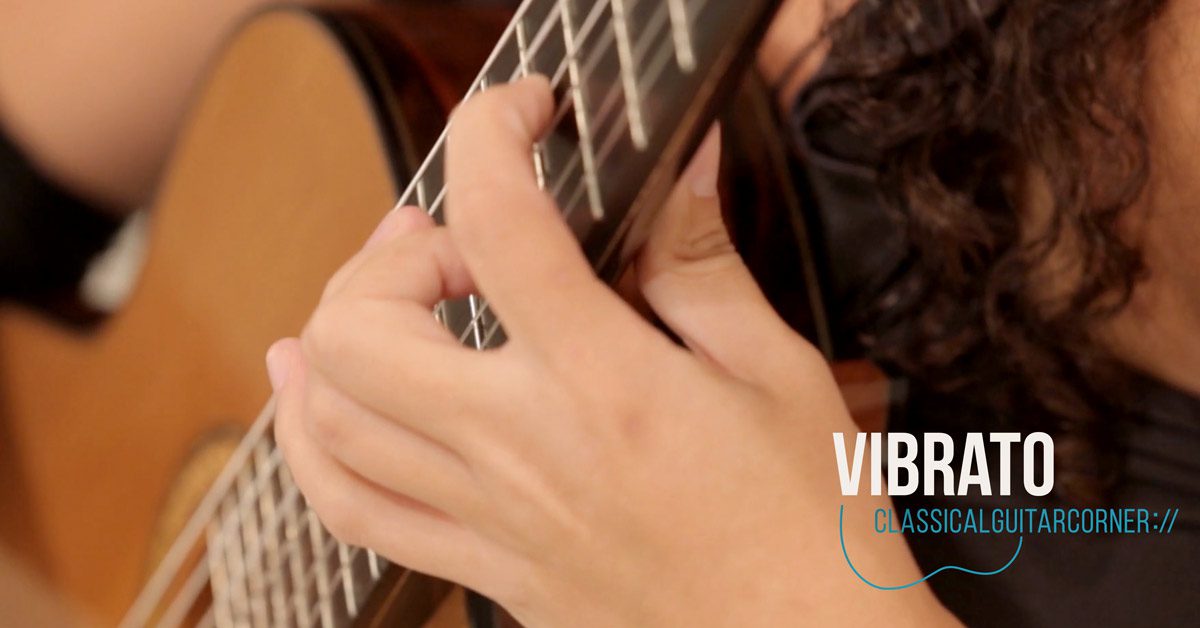
To create vibrato on the guitar you actually have to pull and push the string. In effect you are doing what the tuning pegs do. You are tightening and slackening the strings. When you pull the string towards the tuning pegs you are tightening the tension and the pitch will go up. However, when you push the string down towards the bridge you are lowering the pitch. To make a compelling vibrato, you need to combine the pulling and pushing motion so that the pitch gets distorted slightly above and below the normal pitch.
On electric guitar you will often see players doing a vibrato that bends the string vertically towards the other strings. This bending also tightens the string in the same way that pulling the string horizontally does, this raises the pitch but will never make the pitch go below the original note. This technique is more common on the electric guitar because the strings have a higher tension. You can use this bending technique on the classical (nylon string) guitar but it has a different effect. Sometimes it can be very useful for a special moment where you want to use this bending type of vibrato, but in general classical guitar technique uses the more subtle variety as described above.
Vibrato: Rhythm
There is a wonderful variety available in vibrato technique, and you can add to your color palette by practicing it in different ways. I often find that when a student first has a go at vibrato they simply wiggle their finger and hope for the best. That’s fine if you are trying to get the pitch to start moving, but once you have achieved the basics you might want to think a bit more rhythmically. If a piece is fast and exciting you might want to use a fast ‘tight’ vibrato and if it is more solemn or nostalgic a slower ‘looser’ type of vibrato might be more appropriate.
I think its great to practice vibrato with a metronome. You can start by bending the pitch up and down on each quarter (crotchet) beat, then one for the eighth notes, triplets and sixteenth notes. A vibrato that is actually in rhythmic time with the rest of the music can sound very natural. Thinking of the vibrato in rhythmic terms also means that the quality of the vibrato wont just be random, but you would have taken time to think about how much vibrato you want to use and where.
Vibrato: Sharp or Flat?
In a masterclass that I was lucky enough to a part of, David Russell also suggested thinking about whether you are using vibrato that only flattens the pitch, sharpens the pitch, or uses both. If you listen to the effect of the three different types you will find that there is indeed a difference and the ‘sharp’ version might suit ‘happier’ works and the ‘flat’ version suits more depressed pieces (I know these are not the best ways to describe music, but I hope you get the idea anyway!)
If you have a listen to a solo cellist or violinist, you will notice that vibrato is absolutely everywhere, and when used tastefully it can really enhance the music. I would say, in general, guitarists don’t employ vibrato as much as they could. Have fun experimenting, and I hope it wiggles its way in to your technique!
-Simon
I have come to think that a good amount of vibrato that you see classical guitarists and ukelele players doing is for the visual effect only. As you mentioned, on a fretted instrument you actually have to pull and push on the string in the lengthwise direction of the string to create the vibrato. So a simple swinging or rocking motion wouldn’t create the effect. You actually need to pull and push the tensioned string with one little finger! It takes a good amount of pressure (pulling or otherwise) on the string (which is already pretty tightly tensioned) to pull or slacken the string any more or less than it actually is. The visual effect is clear, which might create an optical/auditory illusion to the brain, but I really doubt that the string is getting pulled and loosened that much. It would be interesting to do a blind test with an oscilloscope to see if the technique is doing anything at all.
If you would listen closely, you would be able to hear it easily. So it’s not an optical illusision.
By the way, the strings are very sensitive. The tone changes even when you change the angle of your fingers a little bit – therefore every tone is unique.
Cheers