
In this lesson
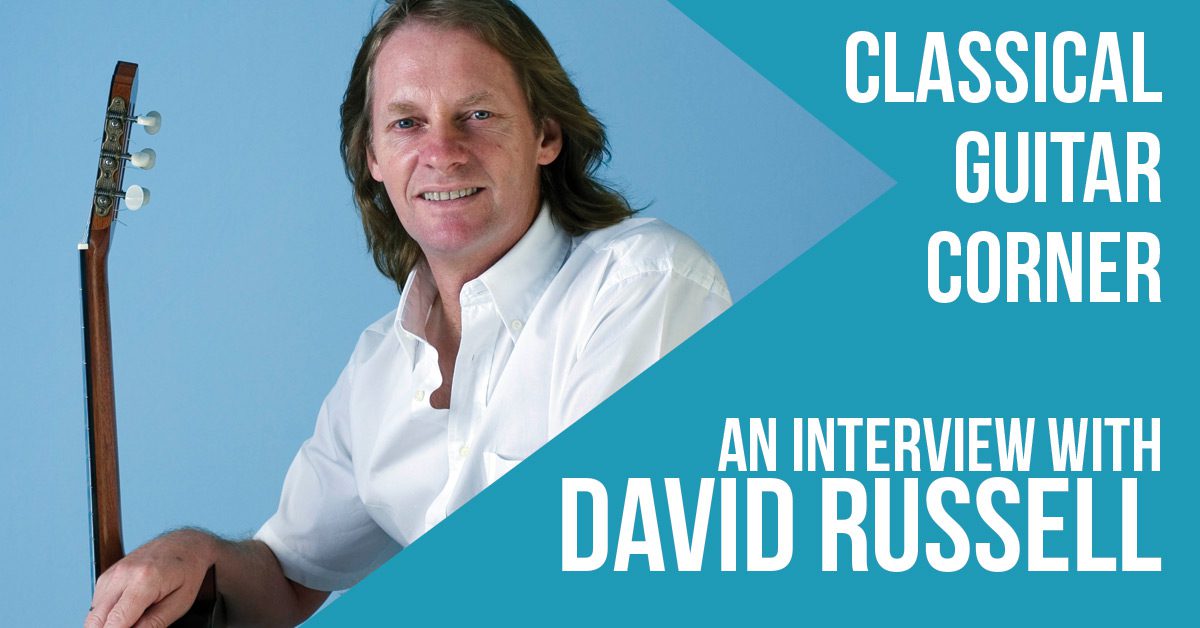
A good lesson can change more than a fingering: it can send a player home wanting to practise. In this conversation, David Russell explains how he approaches masterclasses, why personal discovery matters, and how he organises the large amount of repertoire involved in performing and recording.
Simon also asks about learning new works, ornamentation, the challenges that remain for an established concert artist, and advice for adult amateurs. The conversation ends with Russell reflecting on the charitable work he and his wife María undertook together. His generosity as a teacher and his pleasure in music connect these different subjects.
Podcast: Play in new window | Download
Subscribe: Apple Podcasts | RSS
Originally published in 2015. These listening notes draw on the recorded conversation. Roles, projects, releases and event announcements refer to the time of recording. Practical reflections are suggested applications, not additional quotations from the guest.
Explore the conversation
Use these approximate timestamps to jump to a topic in the recording.
- 4:39 — Begin a masterclass by helping the student succeed
- 10:10 — Let advice become a process of discovery
- 18:50 — Use a practice sheet to notice what you neglect
- 21:08 — Bring attention to the practice session
- 23:44 — Seek feedback early when learning a new work
- 28:58 — Choose repertoire that represents your strengths
- 35:00 — Make an ornament serve the musical line
- 38:21 — Protect the joy that keeps you playing
Begin a masterclass by helping the student succeed
“I want them to remember it with enthusiasm and I want them to go home and want to practice.”
— David Russell, 8:47
Russell describes looking for one or two things he can help a student improve quickly. A fingering, a small adjustment to sound production or another manageable detail can establish that the lesson is useful. Once the student hears a positive difference, it becomes easier to investigate more difficult questions.
He is conscious of how exposed a player can feel in a public lesson. The audience may not create pressure for the teacher, but it certainly can for the student. Having sat in masterclasses himself, he tries to avoid putting the learner on the defensive.
This is a practical teaching principle as much as a performance story. A lesson needs honest feedback, yet that feedback works best when the student can engage with it. A small, audible improvement can create the confidence needed for deeper work.
Let advice become a process of discovery
Discussing technique books, Russell recalls inventing studies and subsequently finding similar ideas in established methods. Discovering a solution himself had value beyond receiving the instruction on a page. He had worked out how the movement related to his own hands and his own problem.
He does not dismiss teaching or useful shortcuts. A concise suggestion at the right moment can open a door. His concern is what happens afterwards: does the student continue investigating, or treat the suggestion as the final answer?
For your own practice, this suggests testing advice actively. Notice what changes, what remains difficult, and whether the solution works in its musical context. A teacher can direct attention and help you hear more clearly, while the understanding develops through your own playing.
Use a practice sheet to notice what you neglect
Russell’s practice sheet is straightforward: repertoire on one side, days across the other, and marks showing what received attention. Its purpose is to stop a favourite piece from consuming the time needed by less immediately attractive work.
A week of marks and gaps makes the pattern visible. He can see which piece has had substantial attention and which has barely been touched. That is particularly useful when new repertoire, concerts and other responsibilities compete for time.
Simon describes using the same idea to help students distinguish enjoyable playing from focused practice. Russell agrees that seeing the marks accumulate can motivate action. The sheet does not prove that a session was productive simply because it lasted a certain time; it helps you direct effort and notice omissions. The original link to his sheet is retained in the resources below.
Bring attention to the practice session
Russell talks about the attitude with which he begins work. When unfinished tasks are distracting him, he may take care of them first. Sometimes he starts with technique; sometimes a piece he enjoys helps him settle into a more receptive musical state.
The point is not to wait indefinitely for inspiration. It is to recognise that hurried, resentful repetition and attentive practice are different experiences. A brief reset can make the next period of work more purposeful.
He returns to basic technique even as an established performer. Simple movements and sound production deserve attention because they underpin more complex playing. His example gives fundamentals a continuing role rather than treating them as material a player permanently leaves behind.
Seek feedback early when learning a new work
When working with a living composer, Russell often sends a video relatively early. It may reveal a wrong note, an unsuitable tempo or a conception that differs from what the composer intended. Asking before an interpretation becomes deeply established makes adjustment easier.
He describes resolving technical obstacles, putting the material together and deciding what he wants to do musically. If he intends to memorize the piece, he tries to address that early too. He also speaks openly about using the score for some repertoire.
There is no single compulsory route here. The useful distinction is to decide what the performance will require and practise towards that situation. If you will play from memory, work on remembering; if you will use the score, develop fluent reading and musical continuity with it.
Choose repertoire that represents your strengths
Russell is candid about limitations. Hearing another player give an exceptional performance does not mean he will be happy with his own version of the same piece. Some music fits his abilities and musical personality better than other music.
He sees choosing suitable repertoire as part of successful performing. A programme should reveal what the player can communicate well. That can coexist with curiosity and the willingness to learn something unfamiliar.
For an amateur, this is permission to maintain two different kinds of repertoire: music that stretches you in practice and music you can already share convincingly. A piece can be worthwhile to study without yet being the right choice for a public performance.
Make an ornament serve the musical line
“If the ornament doesn’t make it sound better, take it out.”
— David Russell, 37:35
Russell explains his interest in cross-string trills through the sound of keyboard music and the playing of Presti and Lagoya. At a cadence, an ornament can intensify the harmony before its resolution. On guitar, a trill that suddenly becomes weak may lose that effect.
Using two strings can provide a different result, particularly in the upper register, but it involves choices. A fingering may require sacrificing another note or adapting an ornament to the instrument. He describes becoming more selective with these effects over time.
His final test is musical usefulness. Simon adds that removing ornaments temporarily can help a student hear the underlying line. Together, those observations suggest a productive order: understand the phrase, explore the ornament, and listen to whether it strengthens what the phrase is doing.
Protect the joy that keeps you playing
“Your enthusiasm for the guitar and your joy of playing is actually the most important thing.”
— David Russell, 38:41
Asked how an adult amateur might use one or two available hours, Russell begins with enjoyment. If a routine is extinguishing the wish to play, it needs reconsidering. He still values dedicated technical work, but its role is to make playing more rewarding.
His own example separates learning and basic work from time spent enjoying pieces he already knows. That balance can be adapted to the time a person actually has. The lesson is not that every session must feel effortless; it is that the overall practice life should sustain the relationship with music.
In the closing conversation, he describes charitable projects with María, including wells and education. He speaks about the perspective this gave him on the worries surrounding a concert, and the satisfaction of helping others. These are recollections from the recording period; the original charity link remains below for readers interested in that part of his story.
Ideas to take into your own music
These prompts are reflections on the conversation, rather than a routine prescribed by the guest.
- Find one achievable improvement: make a short passage noticeably better before tackling every weakness at once.
- Track attention for a week: list your pieces and mark which ones receive focused work; look for the neglected item.
- Test the musical purpose: play a phrase without its ornament, then restore it and compare the effect.
- Keep pleasure in the routine: allow time to play something you love alongside the material you are developing.
Original episode notes and resources
The original introduction and resources are retained below. Any time-sensitive announcements belong to the episode’s publication period.
David Russell is an inspiration to many and this conversation is a testament to his motivation and inspiring attitude. We talk about his masterclass experiences, approach to specific techniques, and his way of practicing new materials.
David and his wife María run a charity, which is mentioned in the conversation and if you would like to find out more, you can visit David’s site here:
http://www.davidrussellguitar.com/index.php/charity
Also mentioned in the podcast is David’s famous practice sheet which he uses to manage the large amounts or repertoire that in involved in touring and recording. Here is a link to that sheet:
http://www.davidrussellguitar.com/index.php/home/tips-for-guitarists/136-practice-sheet
Wonderful! A superlative musician, and an eloquent ambassador for our instrument.
Thanks, Simon, for a very informative interview with David Russell.
Of particular interest to me were his discussions about attitude, and how for some people learning to play is just more hard work than for others.
I have been guilty of searching for the “Golden Key” I recently had the notion that in the US, Abel Carlevaro was not given the prominence other pedagogues are, and if I worked on his Caudermos I might break through the limits I have felt. Well, actually I am still in that phase :)
The thing that has been on my mind from this and especially the John Williams interview was that at the heart of it all we all have to find our own individual paths. Success will be if 5 years from now I still wake up to practice in the morning.
Hi Simon,
I listened to the David Russell podcast as I drove to work this morning. The part that really resonated with me was his discussion about needing to like the piece you’re playing. As a student that is quite an eye opener even though it is obvious. Perhaps naively, I had assumed that if a piece was suggested by a teacher, or by picking up a manuscript, that the piece would be good and whether you liked it or not, you worked at playing it. However, his comments provide some freedom to be selective about the pieces that one puts a lot of time and effort into practising.
I also liked his comment about practising technique in the morning and playing for pleasure in the afternoon/evening.
Another great podcast. Thanks.
As to learning pieces you like: I have had the experience several times where I was not interested in an assigned piece but came to love it through the process of learning it. I was recently assigned Sor’s Op 35 no 16. I listened to a recording of it. I didn’t even hear the phrases-it didn’t seem musical to me at all. By working on it while continuing to listen to others playing, and the guidance of my teacher I have come to love the study. Not incidentally, there are comments on YouTube to the effect that it is an easy piece. By researching the piece through the writing of David Tannenbaum, and Abel Carlevaro, and guidance by Peter Zita, I have come to appreciate how brilliant Sor’s composition is and that to do justice to the work is more challenging than those comments indicate. I would have missed that based on my initial reaction.
This was an excellent interview. His thoughts on teaching and learning were very interesting.
Thank you, Simon. Another interesting and helpful interview for an amateur musician like myself.
And p.s., I also enjoyed your podcast with Evita. Thank you and her for sharing your experiences as artists. And I hope you and your left arm are doing well! We are so fortunate to be able to use our bodies to produce art. Whether it be dancing, visual art or music, etc.
I agree, Karen. If anything it has made me grateful and aware of being so fortunate.
Very interesting to hear from David Russell when he admits he was not a child prodigy but rather a hard worker who loves playing the guitar!
Good suggestion of applying oneself to practice in the morning as a daily discipline.
Again, the advice to “love the playing” seems to run through the interview and to keep challenging oneself to ask questions.
An illuminating interview. Thanks, Simon.
Thank you Simon for this amazing Podcast!! So many wonderful things were covered I found myself sad to hear it end.
David Russel a brilliant artist, and human being. It was so inspiring listening to this interview , it gave me inspiration to enjoy just playing the guitar, while still trying develop or I should say in my case overcome the hurdles, that are challenging me at this time.
Thank you again Simon.
Jimmy
Going to see him on monday in Córdoba (4/7/22)