
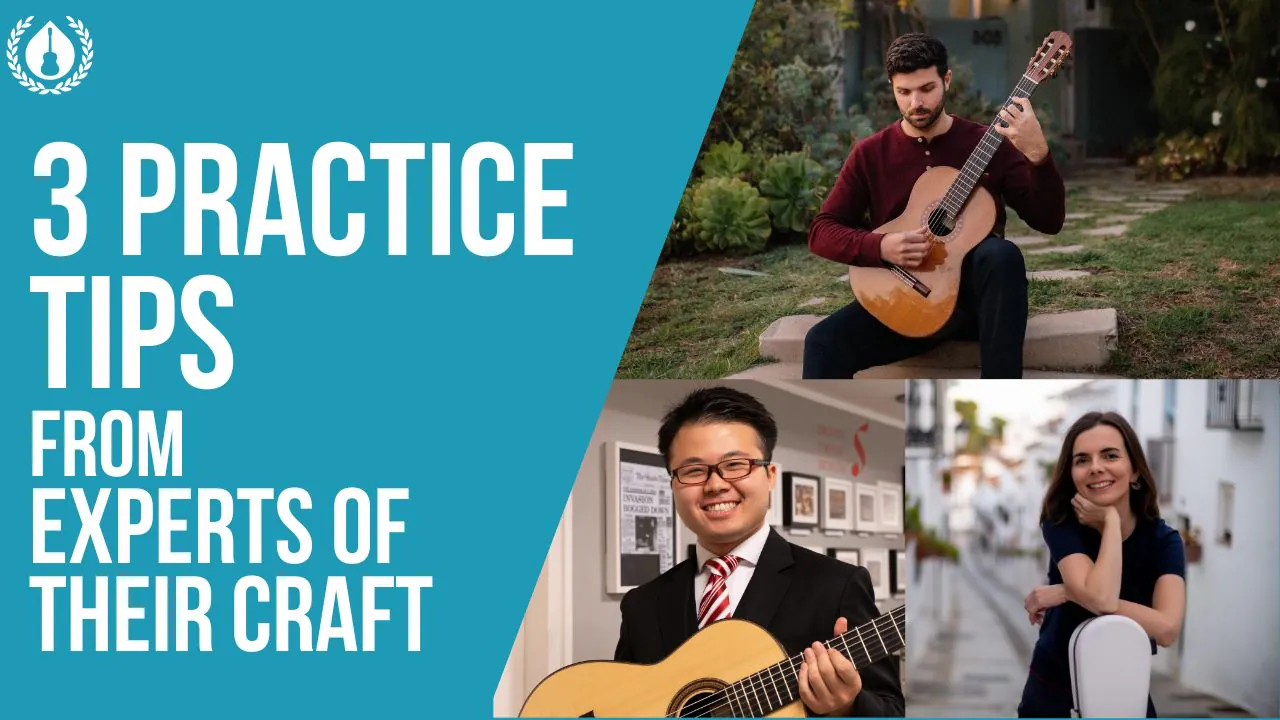
3 Practice Tips from Masters of Their Craft
In this blog article we will offer you 3 practice tips from masters of their craft: Evan Taucher, Sanja Plohl, and Kevin Loh. Each of these classical guitarists have a background in competing and performing at the highest levels. To get to those levels takes not just a lot of practice, but a refined quality approach to practice. So for the month of January we invited each of them to come offer a lecture on how they practice for members of Classical Guitar Corner Academy.
There we have over four and a half hours of practice ideas and tips from these great teachers. And, in truth, practice is a huge topic. So here we will offer just three tips, one from each, on something you can improve now.
To contextualize the conversation, we asked each guest artist to discuss their answers to the following questions:
- What is your daily practice routine?
- How do you learn a new piece of repertoire?
- How do you memorize music?
- How do you manage old repertoire while learning new pieces?
Evan Taucher
To start with, Evan Taucher asked us to consider when we begin to learn the musical ideas in our music. By “musical ideas” Evan means dynamics, phrasing, voicing, rubato…in short, all the things that make a piece come alive. When do you add the musical ideas? And here we come to our first tip:
The most common repeated mistake that comes out of our mouths as students of the guitar, and trust me, I’m not excluded, is, “I’ll add my musical ideas later” . . . 90% of your habits are built playing the piece as flat as Texas out here where I’m at . . . And then you say, oh, now it’s time to add musical ideas. I think it’s the wrong approach. I really think that everything is so much more rewarding . . . when we add in musical ideas from the beginning.
This is a really important insight. The idea of putting in musical ideas after the fact, when 90% of your habits are built already, is akin to relearning the whole piece again. It’s important to remember that we build in habits when we repeat things in our practice. And this is why “practice makes perfect,” Evan stresses, is not quite correct. Rather, “practice makes permanent.” So if you are repeating a “flat” way of playing (devoid of musical ideas), you’re building in those habits that you then have to unlearn later. The above common repeated mistake thus takes twice as long to learn.
But another issue with this approach is that unlearning bad habits takes a lot of time and effort. And sometimes we just don’t put in all the time and effort needed to correct them. So our effort to replace these “bad” habits (playing “flat” and unmusically) with the new habits of playing our musical ideas results in a mixed bag. There are some great musical ideas mixed in with very flat sounding ideas.
So instead, start adding musical ideas right from the start.
Sanja Plohl
Our second guest, CGC Team member Sanja Plohl, talked about our mindset when practicing with respect to mistakes. Mistakes are sort of taboo for many classical musicians. We do our best to practice perfectly so that we can eliminate (and then avoid) all mistakes. But it’s a fiction to imagine that professional guitarists don’t make mistakes when they practice. Yes, building accuracy into your practice — because practice makes permanent — is crucial. But mistakes still happen, for a number of reasons. What is crucial is how we handle mistakes when they do happen. According to Sanja,
Mistakes are your best teacher. Mistakes are your feedback, and there isn’t really anything like a totally random mistake that happened for no reason. If a mistake happens, I’m like, “Hmm…interesting.” And I’ll try to find the reason . . . when you start analyzing mistakes, it actually becomes quite fun to deal with them
The real “mistake” is treating the errors and slip-ups that happen in your practice like something random that happened for no reason. There is no such thing.
What’s more, neuroscience tells us that the effort that goes into the process of finding the source of the problem and then working both to fix and to solidify the solution to the problem makes your solution “stick” more. Sanja talked a lot about what we can learn from recent studies in neuroscience in our practice, and this is a big one.
So don’t be afraid of your mistakes; embrace them and learn from them.
Kevin Loh
In 2023, Kevin Loh was a finalist in the prestigious Guitar Foundation of America competition (in which he took second prize!). The CGC Team were able to be present in the audience to see him perform. It was an astonishing performance. What is even more astonishing is what Kevin told us in his live session about his preparation for that program. Did he run through the program very slowly? Did he do any kind of performance practice in fact just before his performance? The answer is no. He simply went through a couple of technical exercises from Scott Tennant’s Pumping Nylon. And the reason is that he wanted his performance in the final round to be just as relaxed as he had been training his body to be in his practice. And these are exercises he uses daily. But the way he uses them is what is important. Rather than being “engaged” and “active” — tensing the tip joints of the fingers in the right hand and being rigid as they pluck for instance — he allows his body to be completely relaxed. The tip joint in the right hand is allowed to collapse as he practices these exercises so there is no tension present. The upshot? Kevin says,
Practice like you play, play like you practice. So what do I mean? So if I’m practicing . . . in a very engaged and very active way, how am I to expect that when I perform, I suddenly do something different and perform in a relaxed manner, right? And then vice versa . . . Essentially the idea is I wanted to condition how I was playing in the warmup before the final to . . . remind my body, okay, I only need to play in a very light and a very relaxed way, and just reminding my body that that’s how I want to approach my performance . . . for the final.
And this was a key point Kevin kept returning to in his talk: how he is constantly reiterating the practice-performance connection and testing that connection in various ways. He talked about how he uses concepts from speed reading and neuroscience, and how these can help us be more in a “flow” state during performance.
The lynch pin of this process is to practice like you play and to play like you practice.
Conclusion
And, really, this brings us back full circle. If we have the perspective that “practice makes permanent,” and that “there is no such thing as a random mistake,” then we are teaching ourselves to practice in a way that opens up more reliable performance.
Our Member Challenge was fascinating because of all the unique insights each of our guests shared. But they also all shared common insights that influence how they approach practice, and we can learn from those insights. Each of our guests agreed that practice makes permanent; that how you perform very much depends on how you practice; and they all agree that if you don’t have a structured approach to your practice, your performance will be unreliable and a source of frustration. So how can you start to implement these practice truths in your own daily routine?
Call to Action
As you move forward with your practice, here are three takeaways you can start adopting right now:
1. Don’t wait to add your musical ideas until after you’ve learned most of the piece; add them right from the very beginning. This will strengthen your connection with these musical elements because you are working on them for longer, and crafting your whole approach to solving problems with them in mind.
2. Embrace your mistakes. They are “your best teacher” and can help inform you of the things that really need work. And the things that really need work are the things that should be getting most of our attention and time in the practice room. Ironically, this approach will help you build a more accurate, more mistake-free performance.
3. Practice like you play, play like you practice. Just like your musical ideas, you should be thinking of the practice-performance connection from the very start. Create ways to test how reliable your practice problem solving is by performing those sections. There is a lot more to say here, but the more you invest in creating a reciprocal connection between practice and performance, the more reliable both will become.
I’ve been reflecting on the wisdom from the Stephen Convey book, 7 Habits of Highly Effective People lately, in many areas of life. But this all feels very much like his chapter, “Begin with the End in Mind”. Thy greater clarity we have at the beginning, coupled with diligence and patience, the better our chances of achieving our goals. It’s a solid, nearly tangible, frame of mind to try on in the practice room.
What are the latest advancements in neuroscience Sanja was referring to?