

A Template for Learning Repertoire
Over the last fifteen years I’ve written numerous study guides for students at Classical Guitar Corner Academy. While each piece of repertoire has its own unique character, I’ve found that a consistent framework can be applied to almost any work.
This isn’t about making music mechanical. It’s about removing guesswork so you can focus on expression rather than logistics.
Here is the template I return to again and again.
1. Start Smart: Study Before You Play
If you’re like most guitarists, your instinct is to grab the instrument and start reading immediately. Instead, spend 10–15 minutes with the score alone.
When we sight-read, we tend to prioritize:
- Pitch
- Rhythm (sometimes)
- Expression (almost never)
That means dynamics, articulations, phrasing, key changes, and structural details often get ignored at the outset — and whatever we ignore early can become harder to fix later.
Before playing a note, scan for:
- Key and time signatures
- Tempo markings
- Repeats and overall form
- Dynamics and articulations
- Accidentals and complex rhythms
- Dense harmonies or awkward chord shapes
This short “preview” dramatically improves the quality of your first read-through and prevents careless habits from forming.
2. Listen — with Intention
Listening to great recordings can be extremely helpful, especially early on. A strong recording gives you:
- A clear sonic model
- Reinforcement of rhythm and harmony
- A reference for tone and articulation
It also helps you catch wrong notes sooner. If you’ve listened carefully to five high-quality recordings, you’re less likely to internalize an incorrect pitch.
However, there is a downside: listening can influence your interpretation. For some players, especially advanced ones, it can feel like an “aural spoiler.”
My suggestion? Experiment. If you listen, choose reputable performers. And always prioritize the score over any performer’s interpretation.
3. “Arts and Crafts Time”: Make It Visual
One of my favorite study methods is something I jokingly call “arts and crafts time.” It’s simply musical analysis with highlighters.
Guitar notation can look dense because multiple voices are compressed onto a single staff. Separating those voices visually helps you think clearly.
Try this:
- Highlight the melody
- Mark the bass line
- Mark inner voices or accompaniment
Suddenly, the piece becomes easier to understand. You begin to think horizontally — melodically — rather than just vertically as stacked chords.
From there, you can identify:
- Phrases and sub-phrases
- Repeated sections
- Key changes
- Cadences
Analysis doesn’t have to be complicated. Even simple visual separation can clarify your interpretation and improve your voicing.
4. Musical Triage: Identify the Weak Spots
As you begin read-throughs, don’t just play — observe.
Which passages feel unstable?
Which sections require awkward fingering?
Which rhythms feel uncomfortable?
Mark them.
Equally important: mark sections that already feel comfortable so you don’t overspend time on them.
This kind of “musical triage” ensures you allocate practice time intelligently. Recording early attempts can accelerate this process — listening back often reveals issues you didn’t notice while playing.
5. Identify the Real Problem
Practice is problem-solving. But the hardest part is often identifying what the problem actually is.
A stumble rarely spans two measures. More often, it lives between two notes.
Common technical culprits include:
- Left-hand transitions
- Inefficient shifts
- Poor right-hand fingering patterns
- Unnecessary barres
- Excess tension or extra movement
Instead of backing up a full measure and replaying it repeatedly, isolate the precise transition that’s failing. Fix the smallest unit first. Then expand outward.
When you strengthen the weakest link, the entire passage improves quickly.
6. Improve Technique Outside the Piece
Sometimes the issue isn’t the music — it’s your technique.
If a passage demands finger independence, clean barres, or refined voicing, consider creating a short technical exercise separate from the piece.
This prevents you from drilling the repertoire mechanically. It’s often better to elevate your technical ceiling independently and then return to the music with improved tools.
7. Add Fingering Thoughtfully
Fingering decisions shouldn’t be rushed. Once repeated consistently, fingerings become memorized. Changing them later can require significant unlearning.
There are two broad types of fingering:
Musical fingering – chosen for tone, phrasing, vibrato, and color (even if harder).
Technical fingering – chosen for reliability and ease (even if less ideal tonally).
If you’ve worked thoughtfully on a passage for 30 minutes and it remains unreliable, consider that the fingering may be the issue — not your effort.
Also remember: printed fingerings are suggestions, not commandments. They were written for someone else’s hands.
(Beginners, however, may benefit from trusting a reputable edition or teacher early on.)
8. Practice Backwards (In Sections)
Most of us over-practice the opening of a piece and under-practice the later sections.
A simple solution is to practice in reverse order — not note-by-note backwards, but starting with the final section and gradually working toward the beginning.
This balances repetition and prevents the second half of a piece from feeling less secure than the first.
9. Let Memorization Happen Naturally
Many players try to memorize too early. But memorization is built on repetition — and if you repeat before solving problems, you risk memorizing mistakes.
If you’ve done careful score study, analysis, triage, and problem-solving, memorization will already be happening organically. Allow it to develop as a result of good work rather than forcing it prematurely.
10. Pressure-Test the Piece
Certain issues only appear under pressure.
Once a piece feels stable, test it:
- Perform it for someone
- Record a one-take video
- Play it at the end of a long session
- Simulate performance conditions
Then review the recording and adjust. Perhaps a fingering that works in relaxed practice doesn’t hold up under stress. Perhaps your tempo needs refinement.
Pressure-testing refines reliability.
The Big Picture
A systematic approach to learning repertoire isn’t about removing artistry. It’s about building a dependable foundation so that your creativity isn’t interrupted by technical uncertainty.
Remove the guesswork.
Make thoughtful decisions early.
Reinforce them consistently.
And you’ll find that when it’s time to perform, you’re not fighting the music — you’re free to express it.
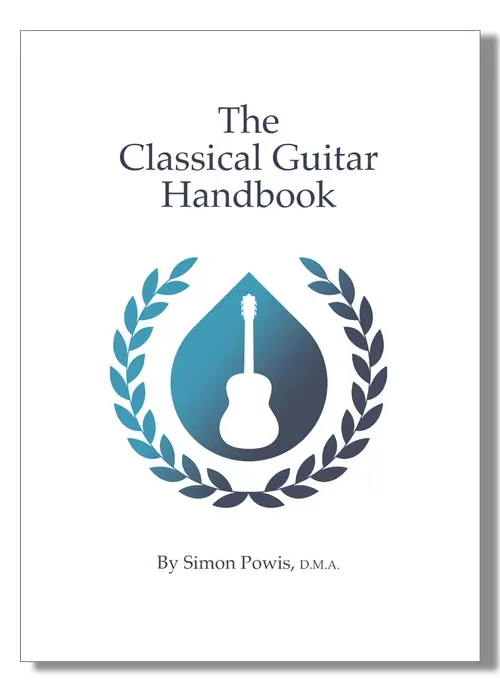
Want more concrete tips that will directly benefit your classical guitar journey? The above thoughts are a condensed form of a chapter from a book I wrote and published recently.
The Classical Guitar Handbook offers a collection of insights and lessons drawn from teachers, students, colleagues, and years of experience on the concert stage. Distilling three decades of teaching and performing, this book provides a wealth of practical wisdom—making it a valuable and versatile resource for any guitarist.
Pick up your copy at the link below.
Leave A Comment