
Sí dolce è’l tormento by Claudio Monteverdi for Classical Guitar (Lesson + Performance)
Sí dolce è’l tormento (“How sweet is the torment”) is one of Monteverdi’s most enduring songs. Monteverdi stands at a turning point in music history, helping shape the move into the Baroque era and the birth of opera. His writing places expression front and center — and that makes this piece ideal for guitar.
This arrangement by Dave Belcher captures the clarity and directness of the original song while sitting beautifully on the instrument.
Key, Opening Harmony, and Space
We are in E minor, confirmed by both the first and last harmony. The piece opens with an E minor triad (E–G–B) under a fermata. Don’t rush it. Hold the chord long enough to establish the tone and atmosphere before moving on. The opening silence and resonance are part of the music.
Immediately after, we encounter an anacrusis (a pickup). Although written in 3/4, this should not feel like a waltz. If the pulse becomes too square — “1-2-3, 1-2-3” — the character shifts too far toward dance. Instead, feel the motion from beat 3 into beat 1. That forward pull gives the melody direction and keeps it vocal in style.
A moderate, unhurried tempo works best. Think in long phrases rather than bar lines.
The Descending Melody
The opening melody descends stepwise from G down to G — essentially outlining a scale. It’s simple and direct. That simplicity is what gives it strength.
Stepwise descent has long been associated with lament, and here it reinforces the reflective quality of the text. Underneath, the lower voice forms its own independent line. Spend time listening to it separately. When practiced alone, you’ll notice it has its own contour and momentum.
Keep the upper voice clearly projected in the A section, but don’t let the bass become passive. When notes in the lower line are written to sustain for three beats, hold them fully. Avoid lifting early — especially on notes like E and C — so the two voices remain independent.
Tone and Balance
This piece benefits from clear tonal contrast between voices.
You might experiment with:
- A warmer, slightly tasto sound for lyrical passages
- More flesh in the thumb for the lower line
- Careful control of open strings so they blend rather than dominate
These small choices add depth without adding complexity.
The B Section: Contrast and Fingering
The B section begins with an ascent in thirds (B–C–D over G–A–B). Thirds create a naturally consonant, singing sound and provide contrast to the earlier descent.
Here, fingering choices matter. Using open strings is practical and appropriate for an early-grade arrangement. Shifting up the fingerboard, however, creates a more connected sound and allows for vibrato. Neither option is “correct” — they simply produce different musical results. Try both and listen carefully.
Later in the section, when the top voice sustains repeated notes while the lower voice moves, bring out the moving line. When roles reverse, shift the balance again. This kind of textural awareness gives shape to the phrasing.
The second half of the B section mirrors the A section with another descending scale — this time from E down to E. Recognizing these large-scale contours can help with memorization and interpretation.
The Ending
The final passage may feel slightly irregular at first. Renaissance phrasing is not always symmetrical. Reconnect with the anacrusis feeling here — lean into the pickup motion. The repeated notes create tension that resolves downward, producing a subtle “yearning” effect.
This is a transparent piece: no technical display, no dense textures. Its success depends on pacing, tone, balance, and attention to line. When shaped carefully, it becomes deeply expressive without being complicated.
Take your time with it. Study the voices. Refine the tone. The rewards are in the details.
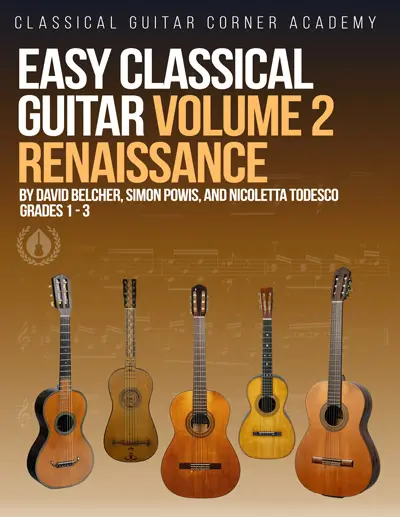
This arrangement of Sí dolce è’l tormento by Monteverdi comes from our new book of easy pieces from the Renaissance. Easy Classical Guitar Volume 2: Renaissance is the follow-up to our popular first volume on the Classical period (which you can pick up for free here).
This new book features 40 solos, all transcribed or arranged from the Renaissance period, and is approachable for Grades 1-3 players. The book includes both notation and TAB. You can purchase a PDF, perfect-binding, or spiral-binding of the book at the link below.
Go buy your copy of Easy Classical Guitar Volume 2: Renaissance here.
Leave A Comment