
In this lesson
Frederic Hand’s conversation with Simon Powis moves through film, opera, teaching, improvisation and memories of Julian Bream. The stories reveal a musical life built from a wide range of skills and from curiosity about opportunities beyond solo recitals.
A central theme is the relationship between technique and expression. Hand questions the idea that a player should first learn the notes and only later add the music, arguing that expressive choices are part of the physical work from the outset.
Podcast: Play in new window | Download
Subscribe: Apple Podcasts | RSS
Originally published in 2016. These listening notes draw on the recorded conversation. Roles, projects, releases and event announcements refer to the time of recording. Practical reflections are suggested applications, not additional quotations from the guest.
Explore the conversation
Use these approximate timestamps to jump to a topic in the recording.
- 6:33 — A varied musical life depends on transferable skills
- 15:01 — Curiosity can reveal possibilities beyond a familiar role
- 25:00 — Technique and expression belong in the same practice session
- 35:01 — Improvisation can grow from pleasure before it becomes useful work
- 43:21 — Julian Bream’s lessons returned to the architecture of music
- 48:12 — Hear where a phrase starts and where it is going
A varied musical life depends on transferable skills
Hand recalls arranging a Vivaldi concerto for the film Kramer vs. Kramer and unexpectedly appearing in the scene with the musicians. Other work brought him into contact with orchestras and opera productions.
He points to reading music and following a conductor as skills that opened opportunities. The guitar part might be small, but the player still needed to function within a larger ensemble.
For a student, this broadens the idea of progress. Reading a simple part fluently, counting rests and entering reliably are worthwhile skills even when they do not resemble a demanding solo. They make it possible to join more kinds of music making.
Curiosity can reveal possibilities beyond a familiar role
Hand’s opera stories include encounters with other plucked instruments and the need to examine an unfamiliar part carefully. His humorous accounts of saying yes are accompanied by examples of recognising when a task required a different solution.
The useful lesson is openness combined with preparation, rather than pretending to possess a skill. Investigating an opportunity can reveal what is possible and what further learning is required.
The conversation also recognises how school ensembles can introduce students to new musical responsibilities. Trying an unfamiliar role in a supported setting can be a valuable part of developing as a musician.
Technique and expression belong in the same practice session
“A crescendo involves technique.”
— Frederic Hand, 26:33
Hand questions a narrow idea of correctness that ends with the right notes and rhythms. A transcription must also make musical sense on the instrument, and expressive decisions cannot simply be attached after the technical work is finished.
Changes of volume, colour and phrasing require particular actions. Practising a passage without those intentions can establish habits that later have to be reconsidered.
Begin with one expressive goal, such as carrying a melody through an accompaniment or shaping a crescendo. Work on the movements needed to realise that goal. This gives technical practice a clear musical purpose.
Improvisation can grow from pleasure before it becomes useful work
Hand recalls improvising with friends simply because they enjoyed it, with no expectation of professional value. Years later, the ability to develop music in a particular style became useful in television work.
The story does not promise that every hobby becomes a career. It shows how playful exploration can develop a musical resource whose future use is impossible to predict.
A small starting point is to vary the rhythm or ending of a phrase you know, or invent a short answer to it. Keep the task modest enough that you can listen to what happens rather than worry about producing a finished composition.
Julian Bream’s lessons returned to the architecture of music
“He was all about music, 100% music, interpretation, sound.”
— Frederic Hand, 43:33
Hand’s recollections of studying with Bream emphasise interpretation, sound and the larger shape of a work. Demonstration at the guitar and piano helped communicate ideas that extended beyond a single fingering or measure.
He describes learning partly through the intensity of listening beside an exceptional musician. At the same time, he recognises that a demonstration by Bream did not automatically become a practical solution he could depend on in an imminent performance.
The balance is useful: let a great performance expand your musical imagination, then do the work of finding a reliable way to approach that idea with your current skills.
Hear where a phrase starts and where it is going
Hand identifies a longer musical arc as something he has observed in great musicians. Attention extends beyond the current bar to the relationship between a beginning, an arrival and the path connecting them.
That perspective links the earlier discussion of technical practice with the memories of Bream. Detailed choices become easier to evaluate when they serve a larger direction.
Mark one destination in a short section and play towards it. Then listen to whether each small change supports that journey. You can investigate this even in simple repertoire; musical direction does not require a virtuosic piece.
Ideas to take into your own music
These prompts are reflections on the conversation, rather than a routine prescribed by the guest.
- Practise an ensemble skill: read an easy part while keeping a steady pulse.
- Include expression early: connect a technical action with a sound you want.
- Make a small variation: explore one phrase without needing to compose a whole piece.
- Hear a longer arc: identify where a section begins and where it arrives.
Original episode notes and resources
The original introduction and resources are retained below. Any time-sensitive announcements belong to the episode’s publication period.
Studies with Julian Bream, rubbing shoulders with Meryl Streep, Dustin Hoffman, Pierre Boulez? Yeah, I want to be a classical guitarist too!
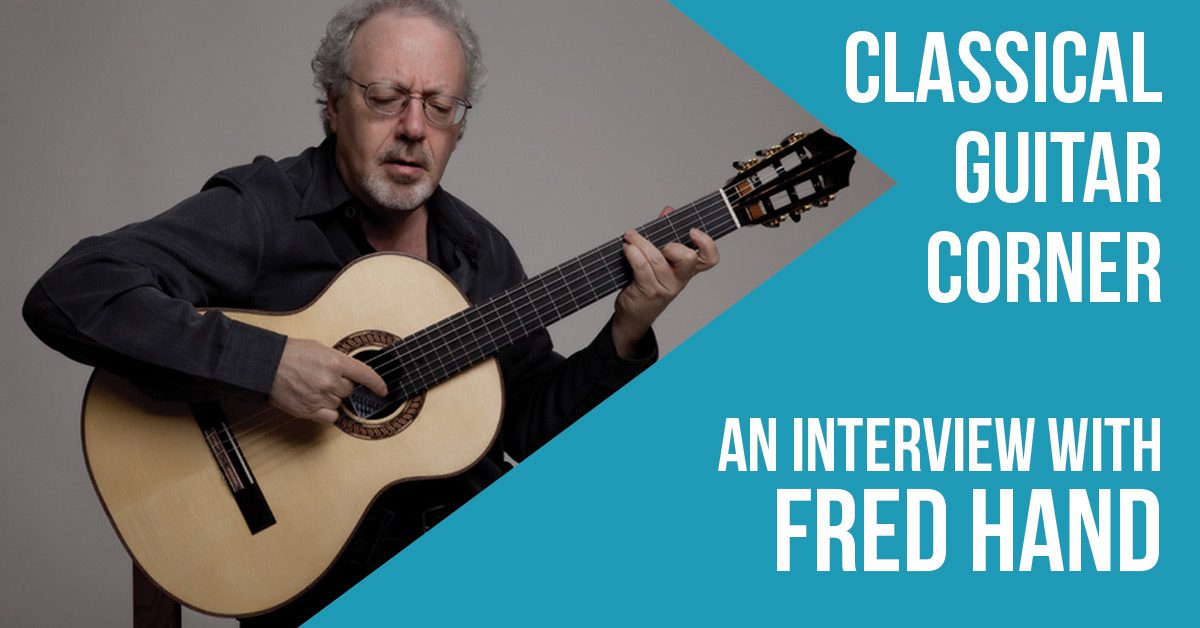
In this inspiring episode of the Classical Guitar Corner Podcast Fred Hand shares stories from a lifetime in music.
Simon–thanks so very much for this interview with Fred. So thoughtful, intelligent, and engaging. You do a wonderful job contributing to the conversation keeping the listener interested and involved. Congratulations on a very fine effort. cheers. Ron
Wonderful podcast, Simon! It’s always a treat to hear Fred share his guitar related stories.
Fred and I had discussions like this many years ago, even before his first recordings were released. He was actually a “classical” guitarist who enjoyed many other musics as as player. I pursued similar interests as well, mostly into jazz and world music, but have always thought that Fred is a world-class guitarist who is actually a better musician than most classical guitarists. Wonderful interview with great insights.
Really enjoyed this and great insight on what motivates and drives musicians.
Wonderful interview, Dr. Powis! I was so engaged and could have listened for another hour. I can’t wait until the next one!
Wow, that was really fun and informative. I can pass along some suggestions, and have a few new goals. Thanks for a wonderful presentation Simon.
€0}~~~##
This was such a wonderful insight into the world of music in general. What I took away from this podcast with two guitarists who clearly love music is that the discipline that we dwell on in the beginning stages of learning this instrument (or any other) is the method by which we squeeze the colors out onto the pallet and then, when the colors are finally all there, we are supposed to paint!! I think in the interview it was refered to as learning the “vocabulary” of the instrument. Thanks Simon for bringing this to us.
Great interview – Simon & Fred – looking forward to the next one. JP
Great podcast, Simon! I would have been quite happy to hear more.
Great podcast. Fred has written a lot of fine music. It is difficult to find all of it that he has recordings for on YouTube.
Fantastic podcast! I am looking forward to part 2.