
In this lesson
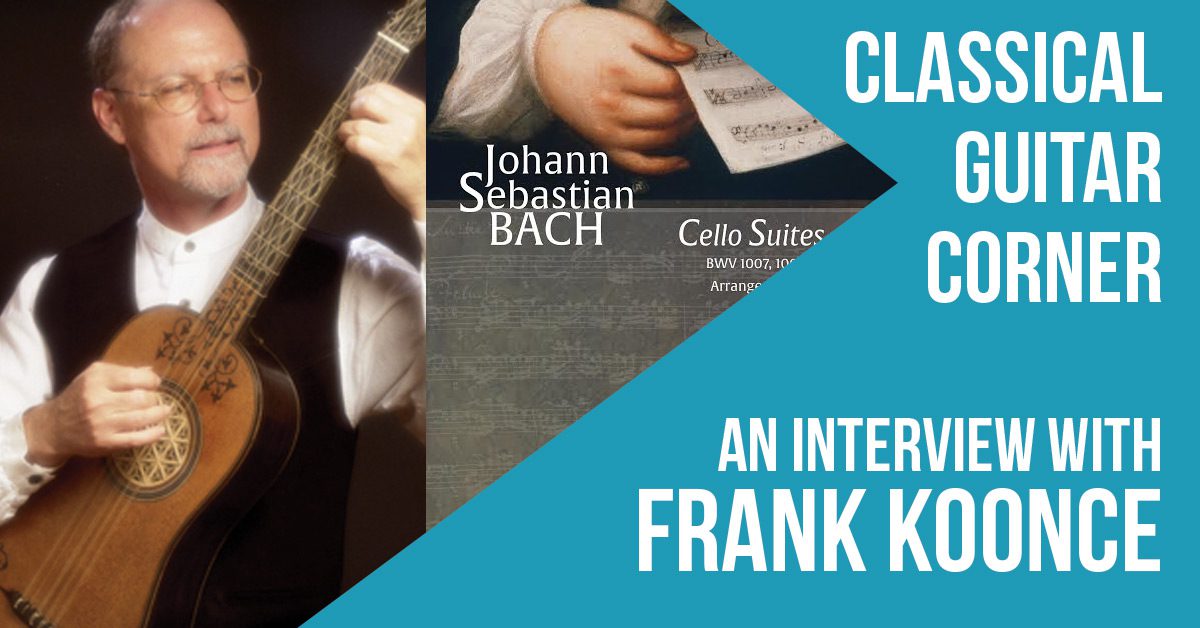
Frank Koonce joins Simon Powis to discuss the decisions behind his Bach editions for guitar. The conversation combines source study with practical experience at the instrument, showing why an edition contains much more than a transfer of notes onto a page.
For students, the interview offers a way to read more actively: identify voices, consider what a fingering is trying to achieve and listen to the effect of note lengths rather than treating the printed result as self-explanatory.
Podcast: Play in new window | Download
Subscribe: Apple Podcasts | RSS
Originally published in 2015. These listening notes draw on the recorded conversation. Roles, projects, releases and event announcements refer to the time of recording. Practical reflections are suggested applications, not additional quotations from the guest.
Explore the conversation
Use these approximate timestamps to jump to a topic in the recording.
- 11:44 — A clear page can help a player hear separate voices
- 13:56 — Source study provides models for making decisions
- 20:51 — The musical result has to justify the physical effort
- 22:39 — An edition can be a starting point for investigation
- 28:25 — Rests and note lengths deserve deliberate attention
- 31:30 — Familiar music continues to reveal new details
A clear page can help a player hear separate voices
Koonce describes the work involved in engraving several voices on a single staff. The layout needs to communicate relationships without creating collisions or visual confusion.
This is particularly important in music where melody, bass and inner parts continue independently. A visually clear edition can help a student understand what belongs to each line.
Before playing a dense passage, trace one voice through the notation. Then play or sing it separately. Seeing the continuation of a line can change what you listen for when the voices are combined.
Source study provides models for making decisions
Koonce explains how he studied Bach’s own reworkings for different instruments. Comparing versions offered examples of how a line might be divided, a chord filled out or a bass added.
He presents that study as a serious attempt to understand the composer’s textures, while acknowledging the judgement involved. An arrangement does not become unquestionable simply because its editor has consulted sources.
For an advanced student, comparing a short passage with its source can reveal which decisions belong to the composer and which to the transcription. That distinction makes it possible to ask more precise questions about the version you play.
The musical result has to justify the physical effort
“If you can create the illusion, you’ve done your job.”
— Frank Koonce, 21:23
Koonce discusses revising earlier solutions and becoming more practical about what could be sustained convincingly on the guitar. Protecting an exposed melody or bass may matter more than an inaudible detail inside the texture.
His analogy is a magician creating a convincing illusion. The audience experiences a musical result, not a diagram of every movement the performer attempted.
This is not an invitation to discard difficult notes casually. It is a reason to listen critically and work with a teacher on the priorities of a passage. A physically elaborate solution should earn its place through what the listener can hear.
An edition can be a starting point for investigation
Koonce distinguishes the needs of a younger student from those of an advanced player ready to experiment. He describes appreciating a student’s different solution even when he prefers another key for his own arrangement.
The discussion makes room for more than one thoughtful approach. A choice can offer a particular resonance or fingering advantage without becoming the only valid version.
When considering a change, state the problem it solves and compare the musical result. That gives experimentation a purpose beyond changing something merely because another option exists.
Rests and note lengths deserve deliberate attention
Koonce argues against ignoring written durations, while also discussing how interpretation, the instrument and the room influence their realisation. A guitar’s resonance creates choices about how and when to stop a sound.
The conversation includes the difference between an abrupt cutoff and a more discreetly managed ending. Listening is necessary because the same physical action can have a different effect in another texture.
Choose a passage with a moving bass and listen for notes that continue beyond their intended role. Work on one ending at a time, then return to the whole phrase so the damping serves continuity rather than interrupting it.
Familiar music continues to reveal new details
“I’m still learning.”
— Frank Koonce, 31:54
After decades of work, Koonce still describes noticing things he had previously missed. The interview closes this part of the discussion with an attitude of continuing study rather than final certainty.
That is encouraging for anyone returning to Bach. Discovering another voice, a more useful fingering or a new relationship is part of the work, even when a piece has been familiar for years.
Keep a record of one question you cannot yet resolve. Returning to it after further listening or a lesson can be more productive than demanding an immediate definitive answer.
Ideas to take into your own music
These prompts are reflections on the conversation, rather than a routine prescribed by the guest.
- Trace a voice: follow its notation before combining the texture.
- Compare with the source: identify one editorial decision.
- Listen to the result: evaluate a fingering by the musical continuity it creates.
- Practise a note ending: make resonance and rests deliberate.
Original episode notes and resources
The original introduction and resources are retained below. Any time-sensitive announcements belong to the episode’s publication period.
It was a pleasure and an education to have Frank Koonce join me on the Classical Guitar Corner podcast to talk about the music of Bach.
Publications by Frank Koonce are available here:
http://www.frankkoonce.com/publications/
Thank you for this post. I am currently studying the Six Unaccompanied Cello Suites by Bach as arranged by Stanley Yates. Also, I recently downloaded a discussion by Frank Koonce and very interested in his work. My study of the Cello Suites has to date only included the first Suite so, I’m very new at Bach. I really like the Allemande, Courante, Minuet I and the Gigue. Thanks, again, for this post.
Well that was just excellent Simon. Thanks so much for posting this wealth of information relating to so many details and aspects of Bach’s music that we love to play on the guitar. Lots to take in and try to apply. Best Wishes.
Does anyone play the first cello suite prelude using professor Koonce’s arrangement? I would love to hear any thoughts on the chromatic ascent building to the final. He uses a single note alternating with the A, versus other editions that use 3rds or 6ths.
In addition to the Bach work, his terrific Platero & I, (two versions-English or a later Spanish language recording) of a Castelnuovo-Tedesco set for spoken voice and guitar has been an obsession of mine for the last two months.
Hi Rick,
Do you have the Koonce edition? I am keen to have a look at it. I discuss that passage in detail in Guitoberfest, so I hope it answers some questions for you. The cello version uses the single line, however, I believe the 6ths add to the excitement and drama of the passage. It really is up to you in the end.
I have both editions. I am very excited to get into the prelude in Guitoberfest. I love the feel and sound of the 6ths but I am thinking about how to make sure the finale is as powerful and triumphant as it should be. I don’t want to go to “eleven,” before that!
Oh, and congratulations on putting some phenomenal podcasts together Simon!
Bravo!
Thanks so much Simon for the excellent podcasts. It’s as if these world-class musicians are in my loungeroom, having a discussion with you about the topics they are passionate about. So insightful- I learn something new with every podcast!
Great podcast! Let’s remember that Frank Koonce has also authored books of Vihuela music and Spanish Baroque guitar music. His catalog also includes much contemporary music. I have been working on his First Cello Suite arrangement – I think his arrangements of the first 3 suites bear witness to his approach to this music in that it is ever evolving.
Excellent podcast, Simon! Very timely for me, as I will be working on the prelude of the first cello suite in Guitoberest. Thank you for all the work you do.
Fascinating interview – thank you!