
In this lesson
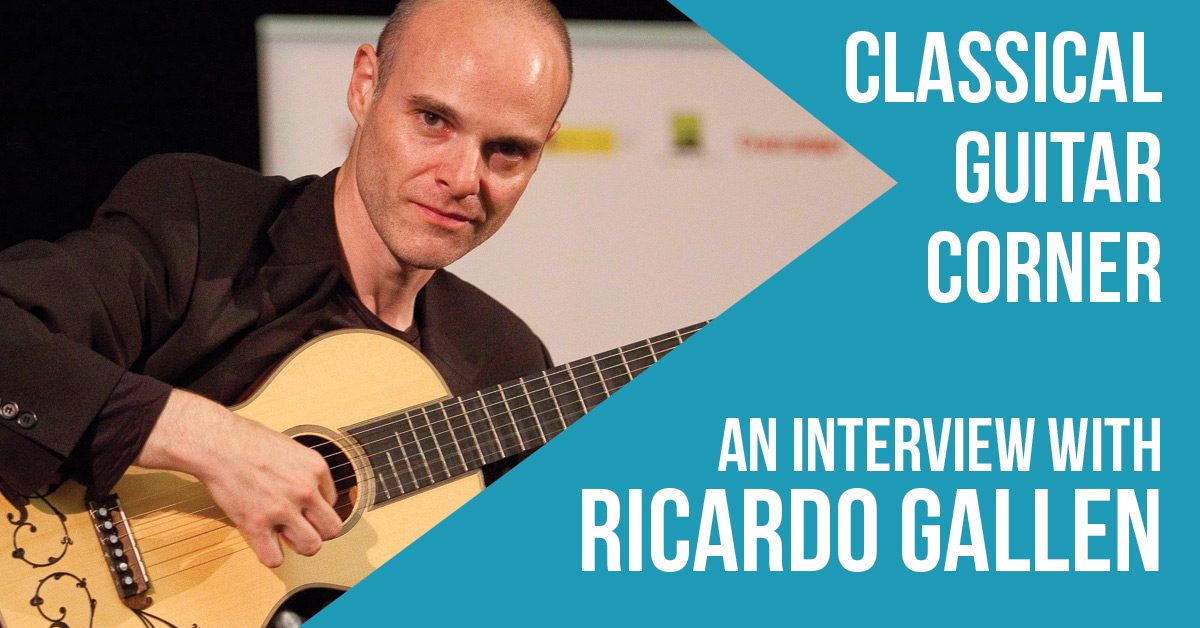
Ricardo Gallén joins Simon Powis at the Cleveland International Guitar Festival for an interview about musical curiosity. His account connects piano playing, close listening, harmonic understanding and detailed work on the guitar.
The central question is practical: how does something you understand about the music become something a listener can hear? Gallén returns to this gap throughout the conversation, drawing on his teaching, his study of Bach and a lifelong habit of investigating how music works.
Podcast: Play in new window | Download
Subscribe: Apple Podcasts | RSS
Originally published in 2016. These listening notes draw on the recorded conversation. Roles, projects, releases and event announcements refer to the time of recording. Practical reflections are suggested applications, not additional quotations from the guest.
Explore the conversation
Use these approximate timestamps to jump to a topic in the recording.
- 5:49 — The piano helps separate a musical idea from a guitar habit
- 9:04 — Analysis matters when it changes what you play
- 14:15 — Learn the individual voices, not only the visible melody
- 18:43 — Curiosity needs a wider musical world
- 26:19 — Technical choices develop through observation
- 36:22 — Listening and historical study inform each other
- 52:35 — Follow the score with a different question each time
- 56:22 — Teaching can make your own understanding more precise
The piano helps separate a musical idea from a guitar habit
Gallén recalls studying both guitar and piano as a child, then continuing to explore the keyboard whenever he had access to one. Even without the technique to play a passage quickly, he found that the piano could reveal structure and harmony in a different way.
He describes trying guitar repertoire on the piano before settling into familiar fingerings. This is particularly illuminating for music by composers whose own experience centred on the keyboard. The aim is to understand the musical thinking behind the notes.
For a guitarist without keyboard skills, the underlying question remains useful: what can you understand before committing to a fingering? Sing the melody, examine the bass or look for repeated patterns. Give the musical idea a chance to become clear before a convenient movement decides the interpretation.
Analysis matters when it changes what you play
“I want to be the boss about what I’m doing.”
— Ricardo Gallén, 10:57
Gallén has encountered students who can explain a score in detail but do not make that understanding audible in performance. Knowing the name of a chord or recognising a phrase structure is only part of the process. The next step is deciding what that information asks of the player.
His approach connects musical decisions with technical investigation. An intended articulation, balance or line may require a different preparation or movement. Technique becomes a way to realise a chosen sound, rather than a set of habits that determines what can be imagined.
Try applying one piece of analysis to a short passage. If you hear a harmonic arrival, decide how the preceding notes lead towards it. Record the result and ask whether the relationship is audible. This keeps analysis connected to listening.
Learn the individual voices, not only the visible melody
Gallén describes separating contrapuntal lines, sometimes writing them on different staves and learning them individually. That work makes it easier to move his attention between voices and understand how they interact.
He also experiments with ornamentation and harmonic patterns. A cadence or melodic idea can be explored in different voices rather than learned only as one fixed sequence of guitar movements. The accumulated vocabulary supports his work with accompaniment and continuo.
For a student, start with a small texture. Play the bass alone, then the melody, and notice where each moves or rests. When you combine them, listen for both lines retaining their shape. The goal is understanding the relationship, not simply increasing the number of notes you can hold at once.
Curiosity needs a wider musical world
Gallén challenges guitarists to listen beyond their own repertoire. He describes discovering orchestral and other instrumental music through family collections, and later seeking out recordings and scores because he wanted to understand what he heard.
One striking story concerns hearing an unfamiliar work by Leo Brouwer and transcribing it from a recording when he could not obtain the score. The example shows the depth of his curiosity, not a requirement that every student undertake a project of that scale.
The original listening challenge is preserved below. A manageable response is to choose one work outside guitar repertoire and listen more than once. Follow a particular instrument or musical idea, then notice whether that experience changes what you hear in your own pieces.
Technical choices develop through observation
The discussion of Gallén’s playing position and hand movements is rooted in his own experience. He recalls seeking comfort, observing musicians on other instruments and becoming more conscious of actions that had begun intuitively.
His examples include right-hand preparation and the timing of release in the left hand. Small decisions affect articulation and the continuity of a line. He describes teaching as a process of investigating those details in relation to the result a student wants.
These recollections are best understood as an account of an individual approach, rather than instructions to copy his posture or unusual fingerings. The transferable practice habit is to ask which movement is necessary for the sound and to investigate that question carefully with a teacher.
Listening and historical study inform each other
Gallén describes becoming familiar with performances on period instruments before learning more about the written sources behind their stylistic choices. Study gave names and explanations to sounds he had already absorbed.
He also acknowledges the limits of certainty about historical performance. Books offer evidence, but individual taste and interpretation remain part of music making. The discussion invites investigation without pretending that a single rule can settle every musical decision.
The relationship between hearing and reading is central. A written explanation becomes more useful when you can connect it with an audible example. Equally, an unfamiliar sound can lead you to a source that helps explain what a performer is doing.
Follow the score with a different question each time
“So you will listen to the music from a different point of view.”
— Ricardo Gallén, 53:23
Gallén describes listening with a score and changing his focus on successive hearings. Following different instruments reveals details that disappear when attention stays on the main melody. He connects this directly with the challenge of hearing several voices within guitar music.
The method can be adapted to a short piece. Listen once for the bass, once for the melody and once for the rhythm between them. Even if you cannot read a large orchestral score, the habit of choosing a listening focus can make familiar music less automatic.
His Bach recording grew from years of listening, studying and teaching. Students’ questions made him examine things that had once felt intuitive, and repeated encounters with the same music continued to reveal new details. The recording project developed over time rather than arriving fully formed.
Teaching can make your own understanding more precise
“But what really helped me a lot is to teach.”
— Ricardo Gallén, 56:15
Gallén explains that a student’s question can expose something a performer has never needed to put into words. Explaining an articulation or identifying why a passage is unconvincing requires another level of attention.
His account of preparing Bach reflects this gradual process. He delayed recording until he felt ready, allowing ideas to mature through performance and teaching. At the end he chooses the Prelude BWV 999 and describes hearing it as an exploration of harmony, with an improvisatory quality.
For your own study, explain one decision aloud as though helping another player. If the explanation is vague, return to the score and sound. You may discover a better reason for the decision—or a reason to try something else.
Ideas to take into your own music
These prompts are reflections on the conversation, rather than a routine prescribed by the guest.
- Hear the harmony: identify one arrival and make its preparation audible.
- Separate the voices: learn a short bass line independently of the melody.
- Listen beyond the guitar: choose a work for another instrument and follow one musical detail.
- Change your listening focus: return to the same passage with a different question.
- Explain a choice: describe why you shaped a phrase in a particular way, then test the explanation by playing it.
Original episode notes and resources
The original introduction and resources are retained below. Any time-sensitive announcements belong to the episode’s publication period.
Ricardo Gallen is a Spanish guitarist that currently teaches in Weimar, Germany. Apart from being an excellent musician, he has several unique approaches to playing and teaching the guitar, which we discuss in this in-depth interview.
You can find out more about Ricardo at his website:
As for the challenge I mentioned in the introduction, here it is:
Ricardo and I talked about the importance of listening to, becoming familiar with, some greats of western classical music. So, I will put three pieces below that are cornerstones of repertory. To really enjoy these, I recommend purchasing a recording and setting aside some time to really immerse yourself. But, if a youtube version is what you would prefer, I will put some links below. They are long pieces, so you might want to make some time for yourself, and enjoy the full performance.
If you do take me up on this challenge I would love to hear any thoughts or reflections below.
Ludwig Van Beethoven, Missa Solemnis

Frederic Chopin, Piano Concerto No. 1
https://www.youtube.com/watch?v=MkrwU5Pd93c
J.S. Bach, B Minor Mass

Ricardo Gallen: a musician’s guitarist. I’ve been obsessing over his peerless Bach recording for a while now, so thank you for this insightful interview, Simon.
Great interview – beautiful person, brilliant player, his BWV 998 Prelude performance is beyond words.
I regularly do listen to classical music.
I like to experience what would be like living on those early periods of civilization, by listening to the sounds created by the great composers.
With Chopin, I find it hard to place myself to any period. I have listened to that music before. Hard to swallow, but not giving up on it.
Maybe too modern/contemporay.
Cheers.
I understand the frustration of a music teacher who realises that most of his students don’t have the background he would expect. Nonetheless, for us, musician Amateurs, And especially guitarists, I think it is already hard enough to get to know our own repertoire, that knowing the rest is almost impossible.
Besides, It’s easy to get overwhelmed and drown if diving into the classical pool without any guidance. So I would love Having a space where we could have access to those western classical cornerstones.
Cheers,
Pitchou.
No I lied. Actually we just need to get our nose off our guitar and start exploring music in general.
It just took me while to realise that the classical guitar wouldn’t be an art by itself without classical music in the first place.
And I tend to enjoy even more the art of the guitar now that I understand where it comes from.
Cheers,
Pitchou
Thanks Simon. Great podcast! I was fortunate to see Ricardo perform, as well as delivering a masterclass at the 2016 Adelaide Guitar Festival. At the masterclass I was struck by his use of the keyboard in making points about the music being performed by the participants. This added a deeper understanding of the music played on that day. Also I noted an ongoing theme in making guitar playing much more biomechanically efficient.
At the festival he played the premier of Leo Brouwer’s piece called ‘Austral’, which was mesmerizing!