
In this lesson
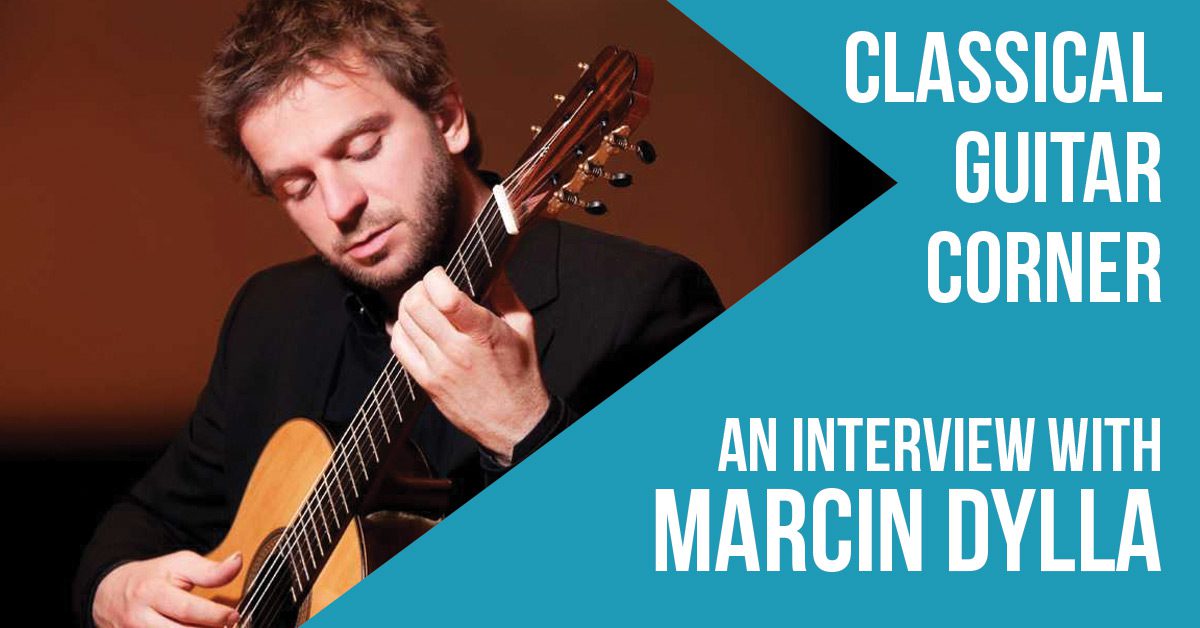
Marcin Dylla’s conversation with Simon Powis explores the work behind a compelling performance: listening closely, asking precise questions and finding inspiration beyond the guitar. He speaks about his early training, his changing relationship with instruments, and the way concerts feed back into the next practice session.
His central challenge to students is simple to state and demanding to follow: know what you are working on. Time spent holding the guitar is not the same as time spent resolving a musical problem. Alongside that disciplined approach, he describes a lasting pleasure in sound, discovery and the possibilities of classical music.
Podcast: Play in new window | Download
Subscribe: Apple Podcasts | RSS
Originally published in 2016. These listening notes draw on the recorded conversation. Roles, projects, releases and event announcements refer to the time of recording. Practical reflections are suggested applications, not additional quotations from the guest.
Explore the conversation
Use these approximate timestamps to jump to a topic in the recording.
- 6:38 — A musical relationship can grow gradually
- 9:26 — Listen to what a different instrument invites you to do
- 13:25 — Use the last performance to guide the next practice
- 19:05 — Ask a precise question before you repeat
- 27:27 — Build exercises from the music you want to play
- 29:02 — Seek musical models beyond the guitar
- 33:54 — Give listening your full attention
- 38:23 — Explore the listening recommendations
A musical relationship can grow gradually
Dylla began lessons as a young child alongside ordinary schooling. Practice became a familiar part of daily life, rather than the result of one dramatic encounter with the instrument. Looking back, he recognises the importance of teachers who could motivate him.
He contrasts this with friends who remember falling in love with the guitar at a particular concert or moment. His own relationship feels more like a happy marriage: established over time and still full of things to discover.
This is useful reassurance for learners whose enthusiasm is steady rather than spectacular. You do not need a romantic origin story to develop a meaningful life with music. Familiarity can deepen into affection as you hear more, understand more and find new ways to express yourself.
Listen to what a different instrument invites you to do
Dylla describes changing guitars because an instrument offers something different, not necessarily because it is objectively better. A new sound or response may make him want to keep playing and discovering what the instrument can offer.
This can affect familiar repertoire. A phrase may work more beautifully in another register, on another string or with a different fingering. In that sense, an instrument can teach him by encouraging choices he might not otherwise have considered.
The wider application does not require buying a guitar. It is to listen to the instrument you have with fresh attention: how does a phrase change across strings or positions, and which version best serves the music? Sound can guide a fingering decision alongside physical convenience.
Use the last performance to guide the next practice
Dylla talks openly about disappointment and the distance between a musical intention and what happens in concert. His response is to analyse what occurred and why, while accepting the human element in performing.
Touring made that process especially clear. Practice between consecutive concerts had a concrete purpose: he remembered what worked, knew what needed attention and could test the result the following evening. The next performance made the feedback immediate.
He also learned to respond to conditions—acoustics, the audience and his own state—rather than expecting everything to be ideal. For a learner, a smaller version is possible: play for a friend or make a recording, identify one useful observation, and prepare another attempt. The performance becomes information you can use.
Ask a precise question before you repeat
“But why it wasn’t good?”
— Marcin Dylla, 26:41
Reflecting on his student years, Dylla recalls hearing advice to sing a melody, listen and think more carefully. He remembered the words before he fully understood what they could do for his playing. In his own teaching, he tries to make the musical result of such advice clear.
He resists giving a number of practice hours as if it guaranteed a particular outcome. Repeating an accidental or inefficient movement for a long time may simply reinforce it. He also recognises that accomplished musicians work extensively: quality of attention does not make effort unnecessary.
The important question comes before repetition. What is the problem, and what would count as an improvement? A vague judgment such as ‘not good’ gives the hands very little direction. A specific observation about a connection, an attack or the balance of voices creates a task you can investigate.
Build exercises from the music you want to play
“And then you practice something, but you know why you do this.”
— Marcin Dylla, 28:23
Dylla makes a distinction between exercises performed without a clear reason and exercises drawn from an actual musical difficulty. He describes taking a troublesome movement, such as a shift between two notes, and exploring it in different positions or on different strings.
The exercise has a visible destination: returning to the phrase and making it work. Knowing why you are doing it can connect technical repetition with the pleasure of playing the piece.
Try applying that idea to a small interruption in a familiar melody. Isolate the connection, simplify the surrounding material, and compare several attempts. Then put the notes back into context. The final measure is whether the musical line has become easier to hear and control.
Seek musical models beyond the guitar
Dylla describes listening to other instruments as a source of inspiration. When he hears guitar playing, his familiarity with its mechanics can draw attention towards how something is being done. Another instrument may make the musical idea more immediately apparent.
Legato, articulation, dynamic range and expressive freedom can sound natural in different ways on piano, violin, cello or voice. The guitar has its own qualities too. The aim is to expand the musical imagination without treating the instrument’s familiar limitations as the boundary of every phrase.
His listening includes contemporary music and larger orchestral works. Discovering a composer through a concerto can lead him to explore that composer’s guitar music. This offers an alternative route into repertoire: follow a musical voice that interests you, then see where it meets your instrument.
Give listening your full attention
“you really have to give something to get more.”
— Marcin Dylla, 37:30
Dylla draws a strong distinction between music used as a background and listening as the main activity. He enjoys music in different settings, but describes focused listening as sitting with the work and following its line, harmony, timing and colour.
The distinction matters for musicians because sustained attention can reveal relationships that are easy to miss while doing something else. A recording does not have to be unfamiliar to reward that kind of listening. Returning to a piece can uncover details that earlier encounters passed over.
This also informs his response to the idea that a recording is fixed and therefore musically finished. The recorded sound remains the same, but the listener changes. Experience, attention and circumstances can make an old recording newly meaningful.
Explore the listening recommendations
At Simon’s invitation, Dylla suggests music that listeners might explore actively. The original resources below include a violin concerto by Pēteris Vasks, a piano concerto by Paweł Mykietyn, and Elliott Carter’s Shard played by David Starobin. Bruckner provides a further, larger-scale listening direction.
He encourages repeated encounters with unfamiliar music. A short work can deserve several hearings; a long one asks for enough time to follow its development. Understanding may begin with curiosity or a striking moment before the whole structure becomes clear.
The recommendations are part of the conversation rather than a compulsory syllabus. Choose one, give it your attention and notice what draws you back. You might follow a changing texture, the return of an idea or the way a phrase gathers and releases energy.
Ideas to take into your own music
These prompts are reflections on the conversation, rather than a routine prescribed by the guest.
- Replace a verdict with a question: instead of ‘that was bad’, identify what happened and what you want to change.
- Make one relevant exercise: extract a difficult movement from your piece, work on it briefly and return to the music.
- Close the feedback loop: record or share a piece, practise one issue it reveals and try again.
- Schedule some attentive listening: choose a short recording and listen without another task competing for attention.
- Revisit a familiar sound: compare the same phrase in two positions and let your ear help decide.
Original episode notes and resources
The original introduction and resources are retained below. Any time-sensitive announcements belong to the episode’s publication period.
I would be happy to hear Marcin Dylla play anything. He is a musician that can combine convincing ideas with exceptional execution. I find that when we come across rare musicians such as Dylla that it is not the music we find beguiling but rather the person from which it is flowing.
As I sat down and listened to his approach and appreciation to music I was unsurprised to find an eloquence and depth of expression that matches his playing. I hope you enjoy this conversation as much as I did, and if you feel like doing a fellow guitarist a favor… pass it on.
Peteris Vasks – Violin Concerto

Pawel Mykietyn – Piano Concerto Mvt 1

Elliot Carter – Shard
Performed by David Starobin

As Marcin Suggested… you might need to crack a bottle of wine to get through the last one:
Anton Bruckner -Symphony No 8 in C minor
Munich Philharmonic Orchestra
Conductor: Sergiu Celibidache

I just went to his concert last Saturday held in Galvin Hall located in Northwestern University. He is such an expressive guitarist and he knows how to use his superb technical versatility so effectively to create his own unique musical expression. I am so lucky to be able to listen his music. He visited us before during the GFA tour, and I was really impressed then, but he is even better. We can feel his concentrated energy and it is so powerful.
Wonderful conversation, very interesting with lots of insight.
Thank you for the podcasts, Simon.
Thanks Simon. Great podcast! I will be listening to it again. There is so much to gain from this conversation.
Wow, the depth of the conversation in terms of truly listening to music versus using music as background was intense. This, in itself, is something that seems to separate Marcin Dylla from many other professionals and definitely comes across in his performances.
Thanks so much for this interview! I found out about Marcin ‘by accident’ while studying Carcassi Etude #7. I didn’t think this was a very expressive piece, particularly, until I saw a short video of Marcin working through the piece and then playing it. Amazing.