
In this lesson
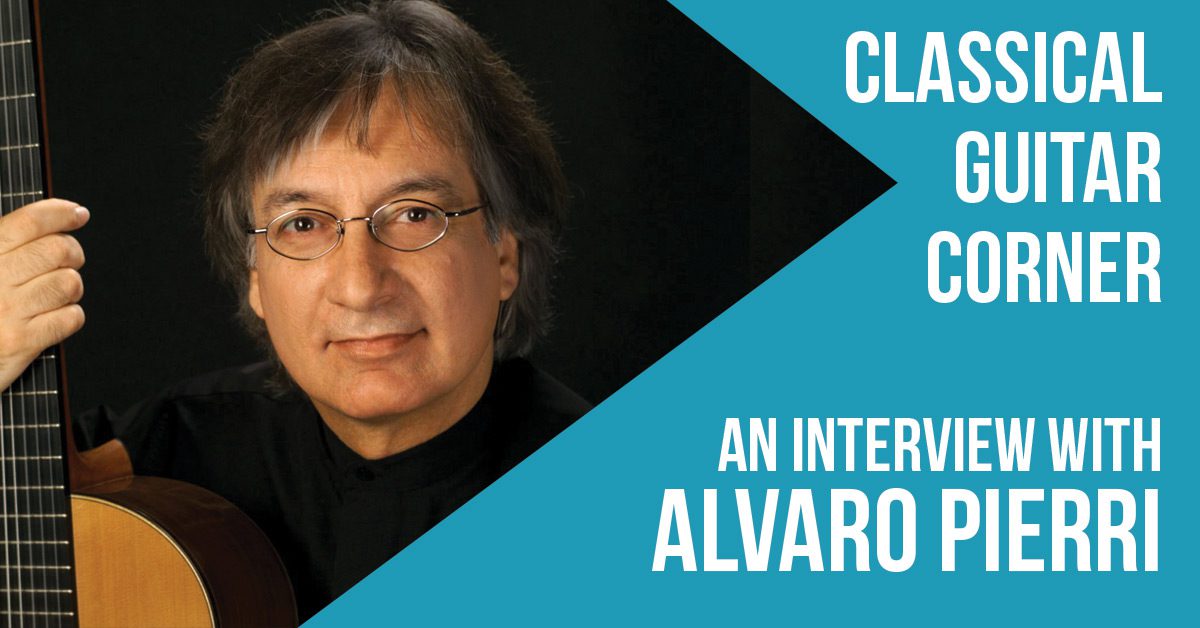
Álvaro Pierri grew up surrounded by musicians, but his education was also shaped by a persistent wish to investigate for himself. In this conversation with Simon Powis, he recalls learning from his aunt Olga Pierri, studying with Abel Carlevaro and Guido Santórsola, and following musical interests that extended well beyond the classical guitar.
The interview moves between family stories, the guitar community in Uruguay, experiences in Brazil, and a philosophy of teaching that encourages independence. Its recurring question is what it means to study seriously. For Pierri, disciplined work can include experimenting, listening, comparing and pursuing an unexpected musical connection.
Podcast: Play in new window | Download
Subscribe: Apple Podcasts | RSS
Originally published in 2017. These listening notes draw on the recorded conversation. Roles, projects, releases and event announcements refer to the time of recording. Practical reflections are suggested applications, not additional quotations from the guest.
Explore the conversation
Use these approximate timestamps to jump to a topic in the recording.
- 4:45 — Growing up inside a musical household
- 15:28 — Curiosity crossed the boundaries of his formal training
- 19:28 — Understand rhythm through its musical culture
- 22:20 — Learn from a tradition without reducing it to one authority
- 34:31 — Anticipate the teacher’s question
- 35:29 — Try another interpretation even when you like the first
- 36:45 — A teacher helps you become your own teacher
- 43:04 — Access to information is only the beginning
- 52:30 — Let serious study include musical play
Growing up inside a musical household
Pierri describes a family in which piano, guitar, singing, composition and folk music were part of the surroundings. His mother taught him piano, his aunt Olga taught guitar, and his grandfather’s musical life supplied another source of experience.
He recalls hearing music and trying to reproduce it at the piano as a small child, and being given a guitar made to his size. Later, living in a larger family household made regular lessons and musical exchange possible.
These recollections describe a particular upbringing, not a prerequisite for learning. What stands out is the variety of contact: hearing music, trying it, receiving guidance and returning to it. Learners beginning later can seek versions of those experiences through recordings, lessons, ensembles and the habit of making music part of daily life.
Curiosity crossed the boundaries of his formal training
“I was always trying, trying things.”
— Álvaro Pierri, 15:45
Alongside a strict classical education, Pierri was attracted to popular music and electric guitar. A recording studio connected with the family exposed him to other performers, and he recalls opportunities to join in. His interests sometimes met resistance at home, yet continued to develop.
His decision to study musicology also came from wanting to investigate. Harmony, counterpoint and analysis mattered, but so did learning how to find things out. He describes the stimulation of approaching musical questions through different methods.
The practical lesson is to give curiosity some direction. When a sound attracts you, try to discover what produces it: a rhythm, a chord movement, a particular articulation or a relationship between instruments. Investigation can turn an enjoyable encounter into something that informs your own playing.
Understand rhythm through its musical culture
Teaching and living in Brazil expanded Pierri’s understanding of music he thought he already knew. He distinguishes learning about a style from encountering the living traditions around it—hearing people play, participating and experiencing dance.
Simon connects this with the dances behind guitar repertoire. Pierri encourages students to engage with movement and with different kinds of music, including popular styles and jazz when possible. His point is that rhythm is experienced as well as counted.
For a guitarist, an accessible starting point is to listen beyond a solo arrangement. Hear the dance, song or ensemble tradition associated with a piece, notice the pulse and accents, and consider how they affect its character. That exploration adds context to the notation rather than replacing careful reading of it.
Learn from a tradition without reducing it to one authority
The conversation includes Pierri’s recollections of Segovia and of the musical community in Uruguay. He describes players sharing music in duos and larger groups, family connections, libraries and the circulation of ideas. These are personal memories and interpretations of that history.
When discussing Carlevaro’s teaching, Pierri also recalls discovering an older method by Pascual Roch in his aunt’s library and noticing connections. The broader picture he presents is of a tradition developing through several people and sources, with later musicians refining what they encounter.
His own choices followed that openness. Despite tensions between people close to him, he wanted to learn from Carlevaro while continuing to work with his aunt. For a student, the useful principle is to evaluate what an idea offers rather than assuming that loyalty to one teacher requires rejecting every other perspective.
Anticipate the teacher’s question
Pierri recalls a game Santórsola proposed: before the lesson, imagine the corrections the teacher might make and try to address them yourself. The teacher would still have something to contribute, but the student would arrive having listened and questioned more actively.
This changed the role of preparation. Instead of waiting to be told what was wrong, Pierri had to consider how a passage was working and what another listener might notice. The exercise encouraged alertness and responsibility.
A useful application is to review one phrase before a lesson and write down a question about it. You might predict that the teacher will ask about the direction of the melody, the balance of voices or an uneven rhythm. Try a solution, then bring both the question and the result. The lesson can build on work you have already begun.
Try another interpretation even when you like the first
“But let us try other ways because for sure I’m gonna discover a lot of things.”
— Álvaro Pierri, 35:41
Pierri describes making variations on his approach to a passage. Having a strong first idea does not close the investigation. Another way of shaping, sounding or thinking about the music may reveal something the preferred version concealed.
This is more than changing things at random. A comparison gives the ear information. Trying a different emphasis may make the harmonic direction clearer; another fingering may expose a colour or connection that changes how you understand the phrase.
He carries this attitude into teaching. A convincing interpretation can emerge from exploring alternatives, and the preferred version can become better understood through that exploration. You may return to your original choice, but with a clearer reason for making it.
A teacher helps you become your own teacher
“the teachers are colleagues with more experience.”
— Álvaro Pierri, 37:06
Pierri describes the teacher as a more experienced colleague, sharing knowledge and ideas while continuing to learn. Explaining the same piece to different students requires adaptation because each person hears, understands and responds differently.
This view does not make guidance unnecessary. It changes what good guidance is meant to achieve. He wants the relationship to stimulate students to take initiative and work things out for themselves.
The responsibility can begin at a manageable level. A beginner may need clear instructions, yet can still notice whether two notes connect or whether a rhythm stays steady. More experienced players can ask broader questions. At each stage, the learner participates in observing and deciding rather than merely receiving a sequence of commands.
Access to information is only the beginning
Near the end, Simon asks how access to scores and recordings has changed. Pierri describes both the benefits of technology and the value of older, slower forms of exploration. Searching a bookshelf could lead him to material he had not set out to find.
He separates access from assimilation. A score can arrive instantly while understanding it still requires attention and time. His discussion of online resources and experiments in remote rehearsal is optimistic, but the tools do not remove the learner’s part in the process.
The stories about music preserved through family connections, including versions of Barrios pieces, also show that repertoire has a history of people, documents and changing versions. For a player, noticing an edition’s source or comparing a passage with another reliable version can be a musical inquiry in its own right.
Let serious study include musical play
Pierri returns to his aunt’s wish that he practise seriously and his own conviction that exploratory listening was serious work. Trying to imitate a recorded sound, investigating jazz harmony or following one musician’s influence to another could absorb him deeply.
His account is not an argument for avoiding effort. He describes an intense engagement with music, but one driven by questions and fascination rather than a single outward form of practice. The activity’s value lay in what he was discovering.
For your own work, that suggests balancing organised tasks with purposeful exploration. Choose a sound you admire, investigate a small part of it and see what you can learn. Curiosity can lead to disciplined attention when there is something you genuinely want to understand.
Ideas to take into your own music
These prompts are reflections on the conversation, rather than a routine prescribed by the guest.
- Bring a question to the lesson: identify one issue, try a response and ask for feedback on what you noticed.
- Compare two interpretations: change one expressive choice in a short phrase and listen to what becomes clearer.
- Explore the context: hear a dance or song tradition connected with the repertoire you are learning.
- Investigate a sound: select a brief recorded gesture and experiment with how to create its character on your instrument.
- Use a resource deeply: spend time with one useful score or recording before adding another to the collection.
Original episode notes and resources
The original introduction and resources are retained below. Any time-sensitive announcements belong to the episode’s publication period.
Álvaro Pierri, born into a musical family in Montevideo, Uruguay, is one of the greatest and most accomplished guitarists of his generation. His early musical education was at the hands of his mother, Ada Estades, on piano and his aunt, Olga Pierri, on guitar (Olga was well known in Uruguay and recorded with a group of three or four other female guitarists: “Conjunto de Guitarras de Olga Pierri”). Pierri won his first competition at the age of 11. Pierri’s later teachers were the legendary Abel Carlevaro and the composer Guido Santórsola.
Pierri has recorded numerous award-winning albums, many of which feature the guitar in chamber settings. He is an internationally acclaimed and in-demand teacher and travels the world teaching masterclasses and workshops at some of the biggest guitar festivals. Currently Pierri is the guitar professor at the Academy of Music at the Vienna University of Music and Performing Arts. Álvaro will be performing at this year’s Guitar Foundation of America Convention in Fullerton, California.
We hope you enjoy this wonderful conversation with Álvaro! Please check out a video of Pierri in a recent performance below, along with a video of Olga Pierri y Sus Conjuntos de Guitarras.


Thank you for this. Serious, useful and enjoyable!
Another wonderful podcast!
Thank you! I appreciate Alvaro’s view that to learn we need curiosity, love and patience.
Yes!!
A happy sound!
Bonnie