
In this lesson
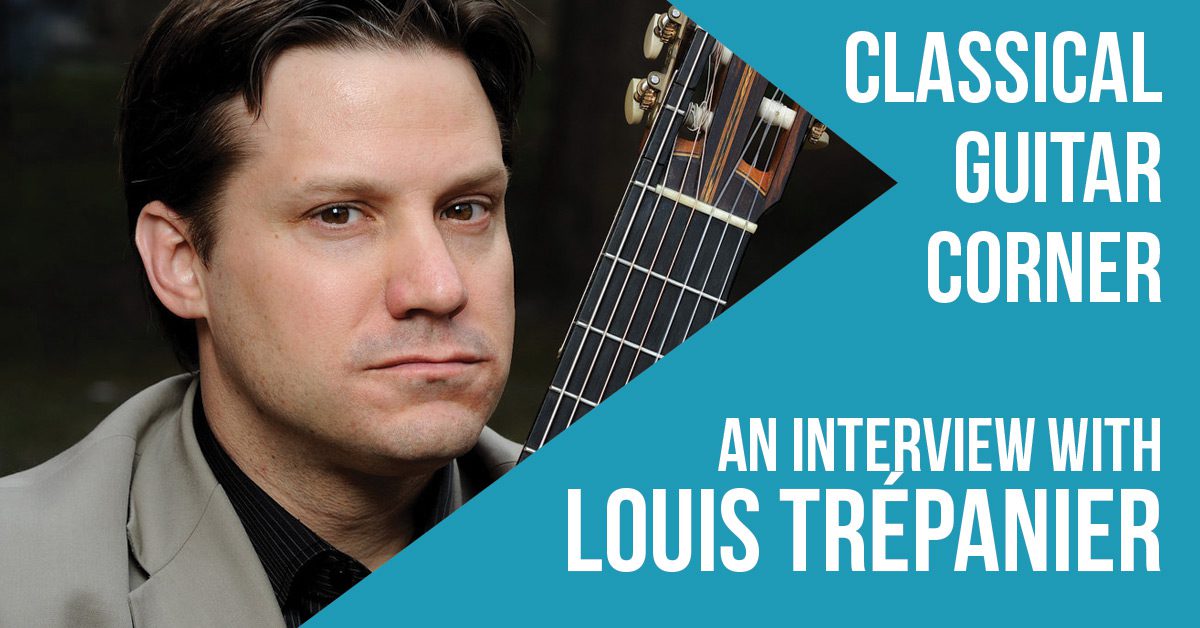
Louis Trépanier joins Simon Powis to discuss life in the Canadian Guitar Quartet. The conversation moves from the group’s beginnings to the detailed work of arranging, rehearsing and performing chamber music from memory.
For students, the interview is particularly useful for understanding why learning your own part is only one stage of ensemble preparation. A group also has to develop a shared sense of rhythm, character and direction.
Podcast: Play in new window | Download
Subscribe: Apple Podcasts | RSS
Originally published in 2017. These listening notes draw on the recorded conversation. Roles, projects, releases and event announcements refer to the time of recording. Practical reflections are suggested applications, not additional quotations from the guest.
Explore the conversation
Use these approximate timestamps to jump to a topic in the recording.
- 4:14 — An ensemble grows through complementary contributions
- 15:00 — An arrangement distributes musical responsibility
- 23:13 — Playing from memory changes the preparation required
- 35:54 — Individual readiness and group readiness are different
- 39:51 — A shared pulse can become a common reference
- 46:21 — Excitement and control need to coexist
An ensemble grows through complementary contributions
“Not only did I really love it, but I felt I really had something to say with it.”
— Louis Trépanier, 15:57
Trépanier recalls being invited to join a new quartet alongside more established musicians. What began as an unexpected opportunity became a setting in which his own musicianship developed.
Arranging offered him a way to contribute something distinctive. Another member was composing for the group, while Trépanier discovered that adapting existing works gave him ideas he wanted to pursue.
This suggests a broad view of participation in an ensemble. Players bring more than instrumental skill: repertoire suggestions, arranging, organisation and a particular musical imagination can all help shape the group.
An arrangement distributes musical responsibility
The discussion includes Brahms and Saint-Saëns arrangements as well as earlier guitar-quartet repertoire. Four similar instruments provide opportunities to exchange melody, bass and accompaniment.
Trépanier also reflects on the practical consequences of frequent role changes. An arrangement can be exciting on paper while creating a substantial challenge for the group’s continuity and shared pulse.
When rehearsing, mark the role of your part at important changes. Knowing when you become the bass, the melody or a quieter accompaniment makes it easier to listen to the right relationship instead of concentrating only on your notes.
Playing from memory changes the preparation required
The quartet’s first concert used scores, and performing from memory developed as part of the group’s identity. Trépanier explains that memorisation required deeper familiarity and more time before a new piece was ready.
He also acknowledges the possibility of things going wrong. Experience and musical knowledge help a group respond, but memorisation does not remove uncertainty or guarantee an uninterrupted performance.
For a student ensemble, memory should be a choice that serves the music and the players. The broader lesson applies with a score too: learn how your part relates to what the others are doing so that you can respond when something changes.
Individual readiness and group readiness are different
Trépanier describes regular, substantial rehearsals and the expectation that players arrive knowing their parts. Even then, an ensemble can need time before the piece feels coherent as a whole.
The rehearsal task changes as a concert approaches. Earlier work may involve discussion and comparison; later work often requires longer passages and complete runs so the musical relationships become dependable.
Choose a rehearsal goal that matches the stage of preparation. If the ensemble cannot yet agree on a phrase, another full run may not solve it. If every detail has been discussed, the group may need uninterrupted playing rather than more conversation.
A shared pulse can become a common reference
Trépanier describes using a metronome in individual practice and early ensemble work. It gives the musicians a common rhythmic reference while they learn how intricate parts interlock.
The aim is not to leave the music permanently attached to a click. He describes removing that reference so the group can breathe and shape the performance together.
Try a short passage first with a shared pulse, then without it. Listen for whether the underlying relationship survives and whether any expressive movement is actually shared by the group.
Excitement and control need to coexist
“I didn’t express beauty”
— Louis Trépanier, 48:53
The conversation considers the difference between a tempo that feels exciting and one that remains under control in performance. Trépanier describes practising slowly and observing his own tendency to push.
He does not reduce a successful performance to the absence of mistakes. Musical expression remains essential, and a technically clean performance can still feel unsatisfying if it does not communicate.
The practical challenge is to choose a tempo at which character and reliability support one another. Record a passage at two nearby speeds and listen for which one conveys the music more clearly.
Ideas to take into your own music
These prompts are reflections on the conversation, rather than a routine prescribed by the guest.
- Mark your ensemble role: identify when you carry melody, bass or accompaniment.
- Match the rehearsal to the problem: distinguish discussion, detail work and complete runs.
- Check a shared pulse: compare a passage with and without a metronome.
- Choose tempo by listening: seek both character and control.
Original episode notes and resources
The original introduction and resources are retained below. Any time-sensitive announcements belong to the episode’s publication period.
Louis Trépanier is a Canadian guitarist (hailing from Ottawa) and a member of the Canadian Guitar Quartet who is the Coordinator of the Guitar Sector at the University of Ottawa School of Music. Trépanier did his formal studies with Patrick Roux, but he has also studied Jazz with the composer and guitarist Randy Ellias. He is responsible for many of the Canadian Guitar Quartet’s arrangements and is a composer of his own works as well (both for the quartet and for solo guitar). Trépanier’s piece “Hoe-Down” for guitar quartet and orchestra appears on Canadian Guitar Quartet’s album Œuvres orchestrales pour quatuor guitares.
For more on the Canadian Guitar Quartet, check out the link here.
What a great interview! Thanks Simon.
Great interview Simon, I appreciate the commentary of Louis as he refers to the varied strengths of the quartet. The tips of achieving rhythm within the quartet are very helpful. The tracks of the quartet playing are wonderful.