
In this lesson
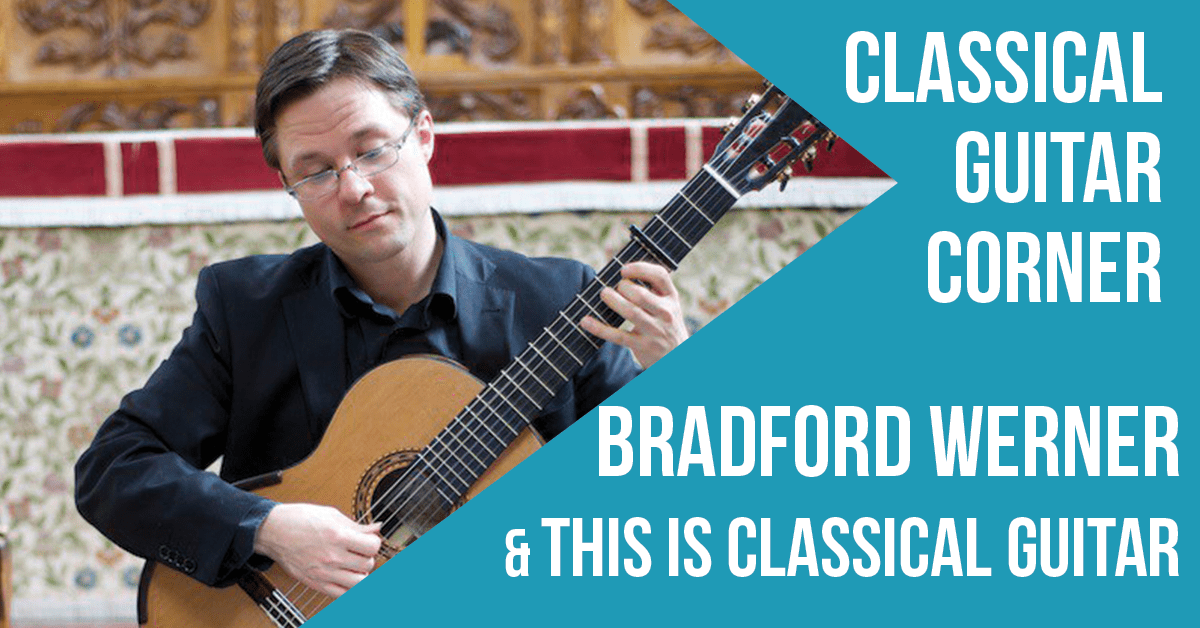
Bradford Werner joins Simon Powis to discuss the beginnings of This Is Classical Guitar and the teaching experiences behind its videos and scores. A resource first intended for his own students developed into a way to share performances, lessons and sheet music with a much wider community.
Alongside the story of a website, this is a conversation about learning online. How should a student interpret advice taken from a single video? What does an edition’s fingering represent? And how does a teacher build trust over time? The discussion offers useful questions for anyone choosing and using classical guitar resources.
Podcast: Play in new window | Download
Subscribe: Apple Podcasts | RSS
Originally published in 2018. These listening notes draw on the recorded conversation. Roles, projects, releases and event announcements refer to the time of recording. Practical reflections are suggested applications, not additional quotations from the guest.
Explore the conversation
Use these approximate timestamps to jump to a topic in the recording.
- 3:26 — Good resources begin with a real student need
- 12:23 — An instruction makes more sense in its musical context
- 23:35 — Fingerings are choices to understand and evaluate
- 27:12 — A score, performance and lesson answer different questions
- 37:11 — Trust grows through a continuing relationship
Good resources begin with a real student need
Werner describes a progression from promoting local concerts to sharing material with a broader audience. One early purpose of the site was straightforward: he wanted his students to see professional players making music with a well-developed technique.
Later in the conversation, he explains how pieces being studied in his teaching studio could become scores and videos. The online material was connected to questions and repertoire he was already working through with students.
For a learner, this suggests a useful way to choose the next resource: start with the question you need answered. A performance might help you hear the overall shape of a piece; a lesson might clarify a movement or fingering. Each resource becomes more useful when its purpose is clear.
An instruction makes more sense in its musical context
“there isn’t always one answer”
— Bradford Werner, 13:16
Werner gives the example of a student returning with notes from an earlier lesson and noticing apparently contradictory advice. The musical situation may have changed, even when the instruction sounds similar. A statement made to solve one problem is not always a rule for every passage.
He describes learning as absorbing a broader musical outlook through repeated encounters with music, teaching and experimentation. That makes a sequence of lessons different from a collection of isolated instructions.
When two teachers appear to disagree, first compare the passage, the sound they want and the difficulty they are addressing. Try to understand the reason for the advice before deciding whether it applies to your own piece. This is especially valuable when a short online clip leaves out the surrounding lesson.
Fingerings are choices to understand and evaluate
Werner mentions requests for scores without fingerings, including requests from students in higher education. As a teacher, he also describes changing an editor’s suggestions to suit his own approach.
The point is not that an edition with fingerings is unhelpful. A suggested fingering can make a piece more accessible and communicate an interpretation. An unmarked score, on the other hand, leaves more of that decision-making visible to the player and teacher.
If you change a printed fingering, identify the reason. Does it improve a connection, support a voice, change a tone colour or make a movement more dependable? Comparing two workable choices can teach more than accepting or rejecting an editor’s solution without listening.
A score, performance and lesson answer different questions
Werner explains his interest in bringing sheet music together with performances and lessons. A visitor can then hear a piece, look at the notation and follow an explanation without having to reconstruct the connection between unrelated resources.
The conversation also covers the balance between free material and paid editions as it stood at the time of the interview. Those details describe the development of his project; they are not a current price list or a promise about present-day access.
A productive study sequence is to listen first for the character of a piece, then follow the score and identify a specific question for the lesson. Return to the performance afterwards and listen for the detail you have just explored. This gives each format a distinct role in your learning.
Trust grows through a continuing relationship
“a slow, gradual build of trust between an individual and users”
— Bradford Werner, 38:01
The interview returns to the personal connection between a teacher and an audience. Werner describes readers who primarily knew his work through a newsletter or a video channel, even when those formats were connected to the same larger project.
He also explains how he initially set aside time for online work as though it were another student. That modest, regular commitment is a useful detail: the collection grew through repeated contributions rather than appearing complete at the outset.
For students, a familiar and reliable teaching voice can make a large body of information easier to navigate. Choose material that helps you make progress, return to it with specific questions, and give yourself time to understand the approach behind individual tips.
Ideas to take into your own music
These prompts are reflections on the conversation, rather than a routine prescribed by the guest.
- Choose a resource for a reason: identify the musical question you want it to answer.
- Check the context: understand the purpose of advice before treating it as a general rule.
- Compare fingerings thoughtfully: listen to the difference and discuss it with your teacher.
- Connect the formats: use a score, performance and lesson together rather than as unrelated browsing.
Original episode notes and resources
The original introduction and resources are retained below. Any time-sensitive announcements belong to the episode’s publication period.
In this week’s episode of The Classical Guitar Corner Podcast, Simon sits down for a conversation with Bradford Werner, who runs the website This Is Classical Guitar, an excellent resource for classical guitarists, as well as a brand new site, Werner Guitar Editions, dedicated to providing high-quality pdfs of classical and fingerstyle guitar editions in pdf format. This is a great conversation we think you’ll really enjoy! Please go visit Bradford’s sites to show him your support, and leave a comment below to join the conversation.
I watched Bradford play some of CGC’s Level 2 repertoire on his YouTube channel. I appreciated learning from his insights on pieces I was diligently working on. This was a month ago, so it is a little surreal to listen to a podcast of a person I just was introduced to through my own searches.
Fantastic to get a peak into his world. Cheers to another great podcast!
I’ve been following Bradford for a year or so. This is Classical Guitar is a great resource! I look at this web site at least weekly and enjoy watching his YouTube videos. I really enjoyed this podcast and getting to know a little bit about him!
I found Bradford’s site when I started trawling the internet for classical guitar info and resources after I retired, so I’ve been following him for longer that I’ve been a member of CGC. It’s a really good site and his regular newsletter, which I subscribe to, has lots of interesting stuff! One of the useful things he has introduced on his site, is review of various guitars and also guitar accessories – I now have a digital tuner and a guitar support, things I didn’t even know existed! I was still using a tuning fork and a footstool!
I really enjoyed the podcast – and I loved his comment about making people pay for his TAB versions as punishment for not learning to read notation! Made me chuckle!
A great resource,cgc,and get to know Bradford Werner,his teaching is great which focus on the fundamentals. Thank you for your generous pdf giveaway..
I have been following Brad online for years. I truly enjoyed hearing my 2 favorite online teachers interacting! Simon, maybe Brad for summer school 2019?
I’ve also been following Bradford Werner’s site for some years. He always makes a very friendly impression and his lessons are quite helpful. His scores – both free and purchased – are very good value. Thank you for interviewing Bradford for this podcast, it was a great idea.
I’ve also followed “This Is Classical Guitar” for some time before I found CGC. I find it really helpful. His recent review of the Codoba C-5 helped to solidify my thoughts for recommending that guitar to my young students. I also really appreciated his more relaxed views with starting out an online business. I just started expanding my teaching to online courses for kids/parents; and have found that it’s quite stressful. I was actually thinking I may not want to continue pursuing it, but when Brad mentioned that he looked upon his online work as “just another student that day”, and you commented about just keep it growing little by little; I felt a sense of relief. And, finally, I really appreciated your comments about the “meanness” of people online; and even feeling like a therapy session was needed! Gosh, I have a youtube channel that a student put up for me (because at the time, I did not know how to do it). The purpose of it was to share their concert videos and share some instructions from me to them so that they would have support between lessons. It was set as public, for their easy access. Some people commented with such terrible things. It was just ridiculous. But, none the less, it does hurt and creates stress. Simon – you are so correct – just one bad comment can carry so much more weight than a load of wonderful comments. So, here is a good comment that I hope you can place on the pile of good to offset any bad comments: I loved this podcast; and I gain new knowledge from every podcast I listen to. Thank you!
I’ve enjoyed the interview very much as being a subscriber to Simon and the CGC and a classical guitar student of Brad’s for five years; it was interesting to hear their respective views on hosting an online presence and teaching online. Brad was a wonderful teacher during my time with him. I will always be grateful for his fine dedication to his students.
Bonnie S.
Very helpful podcast. I particularly enjoyed the dialogue about starting and growing an online presence and the adventures along the way. I didn’t know about his site, but I will look into it now. Also, it is really uplifting to hear how you two pioneers in the field of internet music education listen to and support one another.
Wow, speaking of online comments, what a wonderful group of people here on Classical Guitar Corner. So many nice things to say! Thanks again Simon for doing this.
I found Bardford’s website and videos 3 years ago when I started taking Classical Guitar lessons. I purchased all his books and watched all his videos on technique. It was very helpful and I would have been clueless about technique if I hadn’t watched his videos. Thank you very much.
Really interesting!!! I was not aware of his sites and all that he offers. Thanks, Simon, for introducing me to him.
Hello Bradford and Simon,
Great dialogue, it is interesting to learn about the origin of your sites. The high quality each of you provides is appreciated by many!
Best Regards,
Drew
Great podcast! It’s really interesting to hear the two of you compare notes on online communities. I recently found thisisclassicalguitar.com and there’s lots of good stuff there!!
Thanks!
Judy
I have been following Werner for some time now and have purchased some of his books . Receive his newsletter and actually interested me in classical guitar. Werner actually recommended Simon for a more structured system if seriously considering classical guitar, which I just joined 2 weeks ago.
Interesting to listen to my 2 teachers talking.!!!
Hi Reinaldo,
Welcome! Yes, Bradford is such a great guy and he is doing fantastic work – so I’m glad you’ve been able to enjoy both his materials as well as CGC. Best wishes!
Peace,
Dave B (CGC team)