
In this lesson
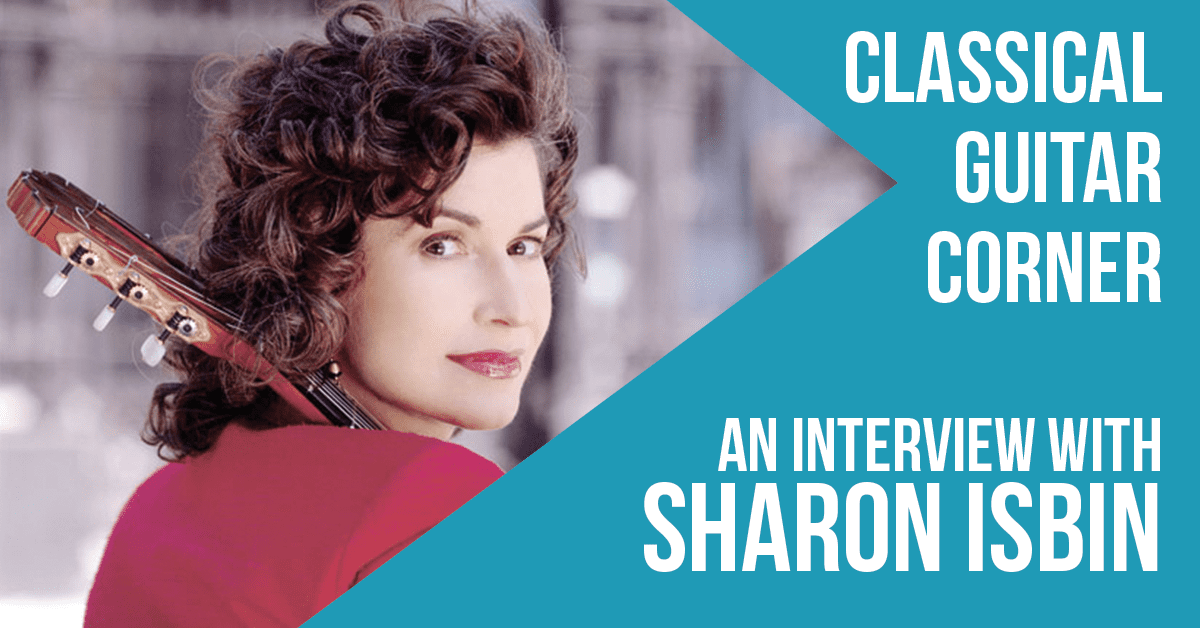
Sharon Isbin’s interview with Simon Powis follows a musical life shaped by teachers, unusual collaborations and the determination to bring new repertoire into being. Her stories include lessons with Segovia, intensive work on Bach with Rosalyn Tureck, and the long process behind a guitar concerto by John Corigliano.
The conversation also explores how she encourages individual strengths in students, what a broad education contributes to a performer, and how opportunities grow through preparation and personal contact. The original notes below retain the featured recordings and links accompanying the episode.
Podcast: Play in new window | Download
Subscribe: Apple Podcasts | RSS
Originally published in 2018. These listening notes draw on the recorded conversation. Roles, projects, releases and event announcements refer to the time of recording. Practical reflections are suggested applications, not additional quotations from the guest.
Explore the conversation
Use these approximate timestamps to jump to a topic in the recording.
- 5:09 — An unexpected beginning and several kinds of teacher
- 9:55 — Go deeper into a piece before moving on
- 15:46 — Be open to possibilities before judging them
- 20:16 — Help a student develop a distinctive strength
- 27:04 — A broad education gives a musician more to say
- 32:42 — Value what preparation gives you, whatever the result
- 34:03 — Bring composers close enough to hear the possibilities
- 40:24 — Let collaboration create new musical relationships
- 42:06 — Make preparation include attention and recovery
- 50:07 — Hear the projects as part of an unfolding story
An unexpected beginning and several kinds of teacher
Isbin recalls beginning guitar almost by accident during a family year in Italy. A lesson intended for her brother became her opportunity when he discovered that the teacher taught classical guitar. Subsequent teachers introduced different kinds of discipline and musical experience.
Her account includes Sophocles Papas insisting on scales, summers studying with Oscar Ghiglia, and Alirio Díaz opening a path into Latin American repertoire. She remembers Segovia’s demonstrations especially for the beauty of the sound heard at close range.
The stories show that an education can accumulate through several relationships. One teacher may sharpen a technical foundation, another open a repertoire, and another provide a sound that remains in the imagination. The value lies in what each encounter helps the student hear and do.
Go deeper into a piece before moving on
“I thought we would move from one movement to the next, but we would just move from one level to the next.”
— Sharon Isbin, 11:15
While studying at Yale, Isbin sought more detailed guidance in Baroque music and began working with Rosalyn Tureck. She describes spending an entire year on Bach’s BWV 996, discovering that progress did not always mean moving to the next movement.
The work involved performance practice, embellishment, fingering and finding guitar solutions to musical ideas proposed by a pianist. The difference between their instruments became part of the collaboration. A musical possibility had to be investigated rather than rejected simply because it was unfamiliar on the guitar.
Isbin recalls Tureck refusing to accept ‘impossible’ before a serious attempt had been made. For a learner, the useful response is to choose one well-known passage and ask what remains to discover. A piece can become more interesting as the work becomes more detailed.
Be open to possibilities before judging them
“One is to keep a very open mind and be open to new possibilities without judgment before you evaluate them,”
— Sharon Isbin, 15:49
Asked to describe her approach to a career, Isbin offers openness and the wish to contribute something distinctive. She connects new projects with falling in love with the music and wanting to bring something into the world that others can enjoy.
Her collaboration with Larry Coryell and Laurindo Almeida illustrates the idea. An invitation that began with one concert developed into years of touring and recording. She trusted the musicians and allowed the arrangements and programme to take shape.
Openness here works alongside judgment, preparation and the abilities of the people involved. The practical reflection is to avoid dismissing an unfamiliar musical invitation before understanding it. A duet, a new style or a piece by a living composer may offer a route into something you did not know you would enjoy.
Help a student develop a distinctive strength
“So when a student has unique and special strengths, I want to see that flower and flourish.”
— Sharon Isbin, 21:46
Isbin describes approaching students individually and encouraging what they do especially well. In the examples she gives, a player’s cultural background, arranging interests or understanding of ornamentation can become part of a distinctive musical contribution.
Her story about encouraging Turkish repertoire and arrangements shows how existing knowledge can become a creative resource. Other examples include performers developing their own interpretations, commissions and collaborations. The aim is not to produce an identical musical profile in every student.
For your own learning, consider what already attracts you. A language, dance tradition, favourite composer or experience in another instrument may offer a useful starting point. Developing a foundation and nurturing an individual interest can happen together.
A broad education gives a musician more to say
Isbin explains choosing a university education that included more than guitar. Theory, writing, languages and other subjects formed part of her development while she continued performing and studying the instrument.
She links engagement with the wider world to having something meaningful to express. The interview also acknowledges practical parts of a career: finding performance opportunities, presentation, photography, recordings and the people who help a project reach an audience.
These details broaden the familiar image of the musician alone in a practice room. Even for someone who does not seek a career, reading, listening and encountering other arts can feed musical imagination. The time away from the instrument can become part of what you bring back to it.
Value what preparation gives you, whatever the result
Discussing competitions, Isbin emphasises the work they can motivate. The chance of winning is uncertain, but a demanding goal can encourage preparation beyond a player’s previous level. That development remains even if the outcome is disappointing.
She also recalls gaining experience through repeated performances before major competitions. Playing a programme for audiences gave her a kind of familiarity that practice alone could not supply.
A useful application is to choose a goal with value in the preparation itself: a class performance, recording, examination or informal recital. Define what you want to improve and what completing the preparation would teach you. The result matters, but it need not be the only measure of the experience.
Bring composers close enough to hear the possibilities
Isbin’s commissioning stories reveal work that listeners rarely see. She recalls asking Ami Maayani to write for guitar, meeting initial resistance, and arranging a chance to play for him. Hearing the instrument helped change the conversation and eventually led to a concerto.
The Corigliano story took longer. Repeated contact over years became a concrete project when an idea involving French troubadours caught his imagination. Scores, demonstrations, recordings, orchestral partners and practical collaboration all became part of making the work happen.
The takeaway is more specific than simple persistence. A collaborator may need to understand what the instrument can offer and find an artistic reason to engage with it. Demonstrating, proposing an idea and helping solve practical questions can be as important as making the original request.
Let collaboration create new musical relationships
Isbin describes Tan Dun drawing connections between the Spanish guitar and the pipa, including strumming, tremolo and bending notes. The resulting music brings traditions into conversation through the sounds and gestures available on the instruments.
Later, she discusses working with Isabel Leonard on Spanish song. Both contributed repertoire ideas, and arrangements helped shape a programme suited to voice and guitar. Touring together before recording allowed the partnership and music time to develop.
These examples show collaboration as an exchange of ideas rather than accompaniment to a finished plan. Even a simple ensemble project can begin by asking each participant what they hear, what they enjoy and what they would like to explore. The result may contain choices neither person would have made alone.
Make preparation include attention and recovery
Isbin discusses meditation as part of her own daily life and describes its personal value for focus and renewal. This portion of the interview is an account of her experience, rather than a requirement for other performers.
Asked about concert preparation, she distinguishes that ongoing routine from something she would introduce only immediately before walking on stage. She also describes reviewing recital repertoire lightly during the day and using mental preparation and visualisation.
The broader reflection is to consider the whole preparation process. More full-intensity playing is not the only available activity before a performance. Listening internally, reviewing the score and planning the musical sequence can also have a place, adapted to the player and the occasion.
Hear the projects as part of an unfolding story
The final part of the episode discusses the documentary Sharon Isbin: Troubadour, recordings, commissions and collaborations that were current or forthcoming when the conversation took place. Those references belong to the original recording period.
The documentary provides another perspective on working with composers and fellow performers, while the featured audio excerpts introduce the range of Isbin’s musical activity. The original episode resources below identify music by Corigliano and Barrios, a collaboration with Steve Vai, and Howard Shore’s music for The Departed.
Listening across those examples gives the career stories an audible context. Notice how the guitar’s role changes between orchestra, another guitarist and a film score, and how different settings invite different kinds of expression.
Ideas to take into your own music
These prompts are reflections on the conversation, rather than a routine prescribed by the guest.
- Return to a familiar work: choose a detail you have not yet investigated rather than immediately adding another piece.
- Explore one new partnership: suggest a manageable duet or shared musical project and invite the other person’s ideas.
- Recognise an individual strength: identify a musical interest or experience you can develop alongside your fundamentals.
- Prepare towards a useful goal: decide what the process should teach you, independent of the eventual result.
- Listen across settings: compare the guitar in solo, chamber and orchestral music and notice what each asks of the player.
Original episode notes and resources
The original introduction and resources are retained below. Any time-sensitive announcements belong to the episode’s publication period.
In this episode of The Classical Guitar Corner Podcast, Simon sits down for an interview with internationally renowned artist Sharon Isbin. Here Sharon shares many wonderful and engaging stories about her life in music and talks about many of her collaborations and projects with some of the most well-known figures in music around the world. This is not an episode you’ll want to miss!
At the beginning of the episode we hear excerpts from three different tracks featuring Sharon:
- John Corigliano, Troubadors: Variations for Guitar and Orchestra
- “Allegro,” from Agustin Barrios’s La Catedral, featuring Steve Vai
- “Beacon Hill,” by Howard Shore from the soundtrack of the film The Departed
If you’d like to learn more about Sharon’s many projects, recordings, collaborations, and performances, please check out her website here.
And for even more check out the new documentary about Sharon’s life and work, Sharon Isbin: Troubador. At this site you can find out more about the film and when it will be broadcast near you.
Wow! What an incredible career! This was so inspirational. Thanks so much, Simon!
A very classy lady you have interviewed in this podcast, Dr. Powis.
One of my favorite moments during the interview was when Sharon spoke about her studies under Rosalyn Tureck. How Rosalyn impressed upon her never to use the word impossible. Whatever musical ideas she threw at her, she wanted Sharon to try. This guidance is something I can really hold to as I approach my own daily lessons/practice.
Brilliant conversation with a brilliant lady.
Sharon Isbin is such a great personality – thank you Simon for this indepth talk with her. It was fascinating to hear about her past, present and future projects/adventures. The story about the concierto by John Corigliano was amazing!