
In this lesson
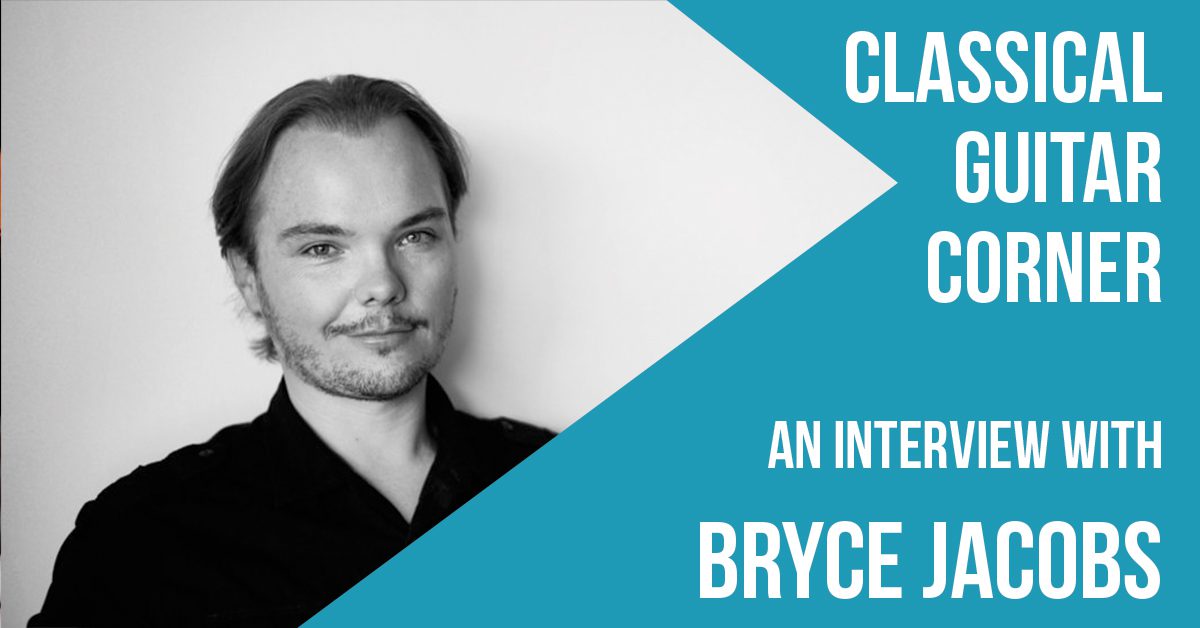
Guitarist and composer Bryce Jacobs joins Simon Powis to discuss a musical path that crosses classical study, bands, instrument design and film scoring. His story shows how skills developed in one setting can become useful in another, sometimes in ways a student could not have planned.
The conversation also considers a harder question: how do you develop your own musical voice while contributing to other people’s projects? Jacobs describes both the opportunities and the uncertainty of that process. These listening notes follow his experiences rather than presenting a single formula for a career in music.
Podcast: Play in new window | Download
Subscribe: Apple Podcasts | RSS
Originally published in 2019. These listening notes draw on the recorded conversation. Roles, projects, releases and event announcements refer to the time of recording. Practical reflections are suggested applications, not additional quotations from the guest.
Explore the conversation
Use these approximate timestamps to jump to a topic in the recording.
- 6:31 — A broad musical education can begin with curiosity
- 20:01 — Hearing a composition reveals what still needs work
- 22:47 — Existing skills can lead to an unexpected role
- 29:11 — Collaboration and an individual voice need room together
- 41:08 — Be prepared for the particular contribution someone needs
A broad musical education can begin with curiosity
Jacobs recalls beginning guitar as a child and becoming absorbed in music that crossed stylistic boundaries. Rock, folk, jazz and classical influences were part of the same developing interest, rather than completely separate musical lives.
That breadth matters to the story that follows. Classical training gave him one set of resources, while playing in other settings brought different sounds, habits and musical expectations. Later work drew on more than one part of that background.
For a classical guitarist, listening outside the usual repertoire can be a practical learning activity. Pick one detail that interests you—a bass line, the pacing of a phrase or an instrumental texture—and ask what makes it work. You do not need to imitate an entire style to learn from it.
Hearing a composition reveals what still needs work
Jacobs describes hearing a big-band arrangement he had written played by real musicians. An ambitious opening did not mean the rest of the piece was equally developed. The experience exposed the gap between an idea on paper and a complete musical result.
He also recalls encouragement from another teacher. Honest feedback and encouragement played different, complementary roles: one revealed what needed attention, while the other helped him see a reason to continue developing the work.
The same distinction can help when reviewing a performance recording. A strong opening or an attractive phrase is worth recognising, but listen to the transitions and ending too. Ask whether the whole piece sustains the intention you hear in its best moments.
Existing skills can lead to an unexpected role
The conversation follows Jacobs through postgraduate composition work, guitar design and the practical work surrounding film scores. He describes reaching out for advice and taking on tasks that connected him with other musicians and production teams.
His account includes work associated with films such as Happy Feet, Rango and Rush, in different capacities. The value of those examples is the range of musical contributions involved: performing, preparing material and collaborating are distinct parts of making a score.
Rather than assuming that a musical education leads to only one job title, the interview invites a more specific inventory. What can you play, hear, arrange, explain or deliver reliably? Those abilities can become useful in combinations that a conventional recital programme does not reveal.
Collaboration and an individual voice need room together
“I want to build my own career and my own voice.”
— Bryce Jacobs, 29:40
Jacobs speaks warmly about significant collaborative experiences, including work with Hans Zimmer. At the same time, he describes the wish to pursue music that expresses his own identity, rather than allowing proximity to a major project to become the whole definition of his career.
That creates a practical tension. Working within another composer’s vision can be absorbing and rewarding, while personal projects require their own time and decisions. The interview does not suggest that resolving this tension is simple or permanent.
For a student, the parallel may be smaller but still useful: learning an interpretation from a teacher and discovering what you want to communicate are connected activities. After understanding a suggested phrase, try explaining the musical reason for it in your own words.
Be prepared for the particular contribution someone needs
“You’ve got to be good at what you do, and you’ve got to want to get better at it.”
— Bryce Jacobs, 41:08
Jacobs links opportunity with both ability and other people’s awareness of that ability. A recommendation is useful when someone knows what you can contribute to the task at hand. His examples repeatedly bring general ambition back to specific musical work.
He also stresses continuing to improve. Being known is not a substitute for having something dependable to offer, and confidence works best alongside a willingness to learn.
An achievable version of this idea is to finish one small project well: prepare a duet part, make a clear recording or arrange a short piece for a particular group. It gives both you and your collaborators a concrete experience of what you can contribute.
Ideas to take into your own music
These prompts are reflections on the conversation, rather than a routine prescribed by the guest.
- Listen across styles: identify one musical detail you can learn from outside your usual repertoire.
- Review the whole piece: give transitions and endings the same attention as a strong opening.
- Name your useful skills: think beyond a single description of yourself as a performer.
- Complete a small collaboration: make your contribution specific, prepared and dependable.
Original episode notes and resources
The original introduction and resources are retained below. Any time-sensitive announcements belong to the episode’s publication period.
In this episode of The Classical Guitar Corner Podcast, Simon interviews film composer and guitarist Bryce Jacobs. This is a fascinating conversation stretching from Bryce’s struggles at conservatory learning classical guitar to some of his stories working with Hans Zimmer on several film scores (including performing guitar on some of them).
To find out more about Bryce’s work, check out his website here.
Music featured in this episode:
“Cavatina” by Stanley Myers (Bryce Jacobs, guitar), Sun Dogs, 2016.
“Holy Frijoles” by Bryce Jacobs, Puss in Boots Soundtrack, 2011.
“Rango and Beans” by Bryce Jacobs, Rango Soundtrack, 2011.
“Guitar F1v1.2 BJ SN1 12” by Bryce Jacobs, Rush Soundtrack, 2012.
Hi Simon This is the second time I listen to your first poscast. Am I dumb I had forgotten that I listened to it, but I remenber now that this listening got me to register into CGC, a decision I shall never regret.
If I were a bit wise I should schedule lisening to it until I can recite it to myself in my dreams ;-)
I wish you had been there when I fell in classical guitar, so much time wasted working wrongly the wrong things :-(
No time to waste crying on that : à l’oeuvre…
Thank you Simon. Bryce offers a compelling narrative of his musical experience. Once again I have enjoyed the insights presented. Mr. Jacobs offers his solid knowledge with honesty and humility. As an interviewer your listening skills encourage reflection. The discussion is an excellent exchange of valuable ideas.