
In this lesson
What makes two musicians sound as though they are thinking together? Matteo Mela and Lorenzo Micheli of SoloDuo join Simon Powis to explore the listening, trust and experience behind their partnership.
Recorded at the Cleveland International Guitar Festival, the conversation offers much more than advice about coordinating notes. It considers how ensemble playing changes a musician’s ears, why singing matters and what a broad education can contribute to an expressive musical life.
Podcast: Play in new window | Download
Subscribe: Apple Podcasts | RSS
Originally published in 2016. These listening notes draw on the recorded conversation. Roles, projects, releases and event announcements refer to the time of recording. Practical reflections are suggested applications, not additional quotations from the guest.
Explore the conversation
Use these approximate timestamps to jump to a topic in the recording.
- 3:39 — A partnership begins with listening and being heard
- 13:51 — Ensemble playing holds a mirror to your habits
- 17:44 — Freedom grows out of work on shared time
- 27:11 — Singing offers a different way into the phrase
- 29:07 — A musical education has value beyond a solo career
- 39:49 — Develop something to say as well as the means to say it
A partnership begins with listening and being heard
“The ability to listen to and to be listened to.”
— SoloDuo, 8:30
The duo recall discovering an unexpected connection while preparing a chamber-music project. An additional duet attracted a strong response, and the experience suggested a partnership worth pursuing. They could respond to each other’s musical ideas without having to explain every detail in advance.
The description of their connection is unusually specific: each feels that the other is paying close attention. That creates room to express an idea freely and trust that a partner will understand it. The result can feel spontaneous even within carefully prepared music.
This does not mean that a new ensemble should expect instant agreement or dispense with cues. The musicians also describe occasions when an unannounced entrance does not work. Their freedom rests on experience and responsiveness, rather than guessing what the other person will do.
Ensemble playing holds a mirror to your habits
When discussing student ensembles, the duo resist offering a single procedure that fits everyone. Players differ in how naturally they listen and adapt. Some respond readily to another person’s articulation; others initially behave as separate soloists whose parts happen to coincide.
Playing with someone else makes your own habits audible. Your sense of pulse, the way you slow down and the amount of space you leave in a phrase all have consequences for another musician. Those habits become matters to discover and negotiate.
For a student duet, choose a short passage and compare how each person phrases it. Then try it together and decide where the music should move or settle. The aim is to build a shared understanding, rather than have one player silently accommodate everything the other does.
Freedom grows out of work on shared time
Mela and Micheli had substantial ensemble experience before forming SoloDuo. Earlier partnerships had already required them to count, listen, discuss and adjust. Some of the ease listeners hear is the result of work absorbed over a long period.
They describe a progression from measured coordination towards flexibility that still makes sense to the other player. Expressive freedom needs a shared pulse. Otherwise an apparently personal interpretation can become difficult for a partner to follow.
The discussion also questions an anxious fixation on striking every note together. Precision matters, but the larger musical idea matters too. A useful rehearsal question is whether both players understand the direction of the phrase, not simply whether individual attacks coincide.
These discoveries can return to solo playing. After listening across two parts in rehearsal, a guitarist may hear the relationships within a solo piece differently: melody against bass, an inner voice, or a phrase that previously passed unnoticed.
Singing offers a different way into the phrase
“Sometimes the only way you have to understand what you play is really to sing it, obviously.”
— SoloDuo, 28:28
The conversation turns to solfège, choral experience and the role of the voice in musical education. The duo describe singing as a practical part of understanding and teaching music, rather than a separate accomplishment reserved for singers.
Guitar fingers can continue moving without the need to breathe. Singing introduces a different constraint and a different kind of awareness: where a line gathers energy, how long it can continue and where it seems to ask for release.
You do not need a polished voice to try this privately. Sing or hum a manageable melody, notice its shape, then return to the instrument. Compare the phrase you imagined with the one your hands produced. If they differ, that gives you a useful practice question.
A musical education has value beyond a solo career
The interview compares experiences of music education and employment in Italy and Switzerland at the time of recording. The musicians discuss teaching, professional ambitions and the value of studying music without expecting it to become a career.
They also recognise teaching as a source of enrichment for the musician, while acknowledging that performance training alone does not answer every educational question. Working with a young beginner requires different tools from coaching an advanced player.
For aspiring professionals, the conversation points towards flexibility and a project connected to something they care about. A degree and long practice hours do not automatically supply a career. For amateur players, the wider point is equally useful: musical study need not be justified only by professional outcomes.
Develop something to say as well as the means to say it
Asked about the guitar’s future, the duo appreciate high technical standards while wanting a broader cultural outlook and more expressive individuality. They describe the danger of having highly developed tools without a compelling musical message.
Their answer reaches beyond practising harder. Listening widely, encountering other arts and paying attention to the world can give a musician more to draw upon. They also value the sense of character and possibility in older performances, even when those performances are less polished by modern standards.
This closes the conversation with a useful challenge. Once a passage is secure, ask what it communicates. A change of colour, a sustained pulse or a carefully shaped silence should belong to an idea. Technical command makes that idea possible; attentive listening helps make it meaningful.
Ideas to take into your own music
These prompts are reflections on the conversation, rather than a routine prescribed by the guest.
- Practise listening together: compare one phrase before deciding how to play it as a duo.
- Make your timing understandable: discuss where a phrase moves and where it relaxes.
- Sing a line: carry its breath and direction back to the guitar.
- Listen inside a solo piece: give the bass or an inner voice a turn as your main focus.
- Broaden your reference points: bring an idea from another musical ensemble into your listening.
Original episode notes and resources
The original introduction and resources are retained below. Any time-sensitive announcements belong to the episode’s publication period.
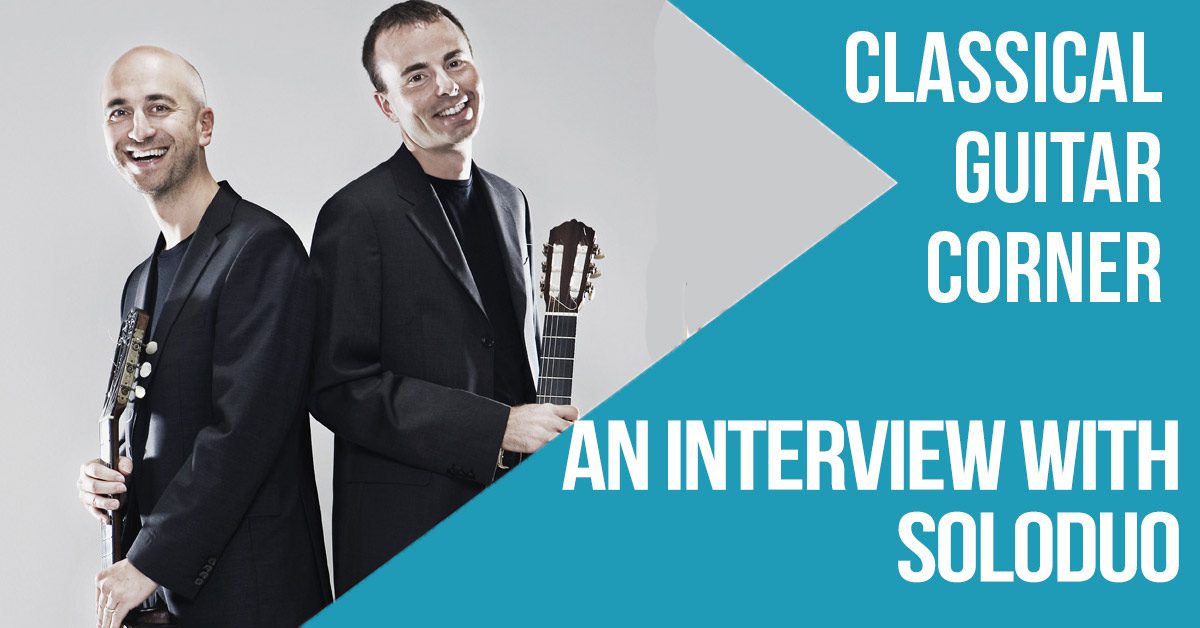
SoloDuo is a classical guitar ensemble comprising of Matteo Mela and Lorenzo Micheli. Their work is revered and respected throughout the guitar community and they are also a pleasure to talk to!
Our conversation weaved from what it is like to play in such an in-synch ensemble to ensemble education and guitar education in general.
You can find more about SoloDuo at http://www.soloduo.it/
Great interview Simon! I stumbled upon them in you tube and was very impressed at how they play well together and in sync! Playing in an ensemble is something I would definitely want to experience. I like the way they described how much discussions and discovery occur at first with the ultimate goal being to start playing freely…enjoyed this very much! Thanks!