

Graded Studies for Classical Guitar by Simon Powis
The Cornerstone Method for Classical Guitar is my completely new revision of the graded curriculum for members of CGC Academy. It provides a structured pathway for beginners all the way up to advanced classical guitarists. The curriculum forms a pathway of materials from technique to repertoire to focused studies to theory and more.
For Grades 2 and 3 I wrote a substantial number of studies that would accompany all of this material. Like the teacher-student duets in Grade 1, each study has a distinct pedagogical purpose in a fun musical style. These studies thus make a nice break from the typical nineteenth-century studies early guitarists may already be familiar with.
The Cornerstone Method for Classical Guitar: Grade 1 book has already been published and we hope to release both the Grades 2 and 3 books over the next year as well.
Below I’ll introduce you to each of The Cornerstone Method studies with a brief description, some also including performance videos.
Grade 2 Studies
Study No. 1 (Thumb Control)
The first study focuses on controlling the thumb while jumping across bass strings. For instance, the thumb must hop from the sixth to the fourth string and back. After the player gets used to this motion, then fingers are introduced playing block chords over this thumb-jumping movement. This adds a further challenge to keep the thumb control in a context with multiple voices.
Study No. 2 (Sustaining Notes)
And actually the concept of multiple voices is a big part of Grade 2, as much of the repertoire in Grade 1 only has one voice or a voice plus accompaniment. In Study No.2 bass notes must sustain as notes in the upper voice are moving. This requires some left-hand independence, which we will return to later, but also listening to the duration of each separate voice.
Study No. 3 (Right-Hand Balance)
In this first of two right-hand balance studies, you must bring out the long held notes. Sometimes this means letting a bass note sustain; other times it means letting one note in an arpeggio continue to ring over the others. In either case, the longer note must be louder than the softer accompaniment.
Study No. 4 (Right-Hand Balance)
The second study on right-hand balance sees the melody shift from the bass to the treble and back to the bass. The challenge is to bring out the melody in this shifting musical context, and so the other voice must remain soft.
Study No. 5 (Dynamic Accents)
Here you must hold down left-hand fingers as long as possible to let the harmony resonate. Accents indicate where the melody is embedded in that musical texture. The challenge here is both to allow the melody notes to stand out while allowing the harmony to resonate.
Study No. 6 (Right-Hand Staccato)
This study places a melody in the bass with the thumb, while the fingers must play the treble accompaniment part with staccato. Some notes in the accompaniment are legato and so the student must pay close attention to the different articulations.
Study No. 7 (Second-Position Syncopation)
All of the notes in this study are to be played in second position. Ties in the upper voice extend across barlines, which make melodic notes syncopated. Allow each note to sustain for its full duration to create a smooth connected line, even on the upbeats.
Study No. 8 (Second Position and Finger Alignment)
Left-hand fingers must be in perfect alignment in this exercise to allow musical textures to resonate. Lower notes are held while upper notes ring out. If your fingers are not curled, you will mute the upper strings. This study requires good string clearance in the left hand. It also combines some of the other elements we’ve been covering in the process.
Study No. 9 (Left-Hand Independence)
One thing we do often on the guitar is to hold a note with one finger while others must move. This is just the nature of playing a polyphonic instrument. This study requires you to hold lower notes while upper notes are moving. Be sure to keep fingers down for their full duration!
Study No. 10 (Two-String Barre)
The barre is one of the most challenging left-hand techniques for all guitarists. And this is one of those techniques it will take you time to master, even beyond Grade 2. So here we start with a simple two-string barre to get accustomed to using the first finger to hold two strings at once. The study moves in and out of open strings and first-fret barres before incorporating the barre into a more musical arpeggio texture.
Study No. 11 (Drop-D Tuning)
Much of the classical guitar’s repertoire requires you to tune the sixth string down to D. This is the most important of the guitar’s “scordatura” and one you’ll encounter frequently, so it’s good to get accustomed to it early. This study focuses on the key of D minor (don’t forget the B-flat!) and especially the bass notes in this key.
Study No. 12 (Staccato)
In this study we mix both right-hand and left-hand staccato. Sometimes a left-hand finger can “pulse” on the string by lifting off the fret while still touching the string. Other times the pad of the left-hand finger must touch a higher adjacent string while fretting a lower string. Learning to combine these two techniques with right-hand staccato will allow you to use different articulations freely in different contexts.
Study No. 13 (Tempo Rubato)
The final study of Grade 2 has two main focuses: (1) incorporating all of the different techniques and musical concepts we’ve learned in the grade; and (2) developing our use of tempo rubato learned in the final lesson of the grade.
Grade 3 Studies
Study No. 14 (Shifting and Guide Fingers)
In Grade 2 we introduced shifting by one fret. Here in Grade 3 we build on that to include larger shifts, up to fifth position and back to first. This study uses guide fingers (fingers that stay on the string as we shift from one position to another) and shifts, both large and small. To build on another element from Grade 2, this study also asks you to have good finger alignment to promote good string clearance in the left hand.
Study No. 15 (Slurs)
This study offers a variety of slurs that requires a steady rhythm, a solid left-hand position, and good slur technique. Along with the slurs, we have also incorporated the South American 3-3-2 rhythm first introduced in the duet Fifth-Position Milonga.
Study No. 16 (6/8 Time)
Something you’ll encounter frequently in these studies is that they bring together elements you’ve already worked on to continue to deepen your knowledge of them. For instance, here we place shifting, guide fingers, pivot fingers, and fifth-position playing in the context of 6/8 time.
Study No. 17 (The Small Barre)
Here we build on the two-string barre we first introduced in Grade 2 by adding the three-string barre. This study explores the short or small barre by offering a repeated phrase with different left-hand requirements. You’ll find both two- and three-string barres throughout.
Study No. 18 (Flesh-Tone Thumb)
The thumb has a whole palette of colors at its disposal. In this study we focus on using “flesh-tone” with the thumb for the first half and then switch to using the nail for a nice color contrast. There is a cheeky Beethoven quote in here—see if you can spot it!
Study No. 19 (Right-Hand Preparation)
This study looks intimidating. But if you play it slowly, as indicated (Lento!), it will help you build up your right-hand preparation. You could view this almost as a tremolo preparation study, but put that out of your mind for now. It really is all about alternating between staccato on one string and using that same movement as an arpeggio. That is the effect of right-hand preparation.
Study No. 20 (Descending Slurs)
Here you’ll find a pretty challenging study. It is in 12/8 and features many descending slurs (no surprise there) throughout. Despite the challenges, it is a really great workout. This is a lyrical study where the rhythm can be a bit flexible.
Study No. 21 (Ascending Slurs)
Just as Study 20 focuses on descending slurs, here we focus on ascending slurs. This study uses a “sotto voce” (soft whisper voice) and is marked “Andante tranquillo” so everything should be really soft and calm. The goal here should be to make the melody stand out, but still be soft. That means taking care of the tone of the first string so it’s equally soft and calm.
Study No. 22 (The Triplet)
This study works out your triplet rhythms in a jazz ballad context. Here the triplets are couched between quarter notes in some measures, eighths and sixteenths in others. That allows you to control the differences between these eighth-note triplets and other duplets.
Study No. 23 (Tone Control)
There are three distinct challenges: one is a melody that is heavily reliant on the a finger, the melody is often on the first string, and there are many open strings throughout. Your challenge is to control the tone when you encounter these different elements that tend to disrupt a consistent nice sound.
Study No. 24 (Fixed-Finger Slurs)
Slurs often occur on the classical guitar while we are holding down bass notes. This study focuses on this challenge by giving you “fixed-finger” slurs, where bass notes must be held as other fingers perform slurs. The music is reminiscent of an adagio by J.S. Bach, with a steady flesh-tone bass.
Study No. 25 (Natural Harmonics)
Here you have two challenges: deciphering harmonics in musical notation, and playing natural harmonics at both the seventh and twelfth frets.
Study No. 26 (Non-Chordal Tones)
This final study in Grade 3 not only pulls together all of the elements we’ve worked on in this grade but also challenges you to musically perform a variety of non-chordal tones. The most important lesson here is to play the non-chordal tone louder than its resolution. So this study is at least in part about controlling melodic and musical lines dynamically.
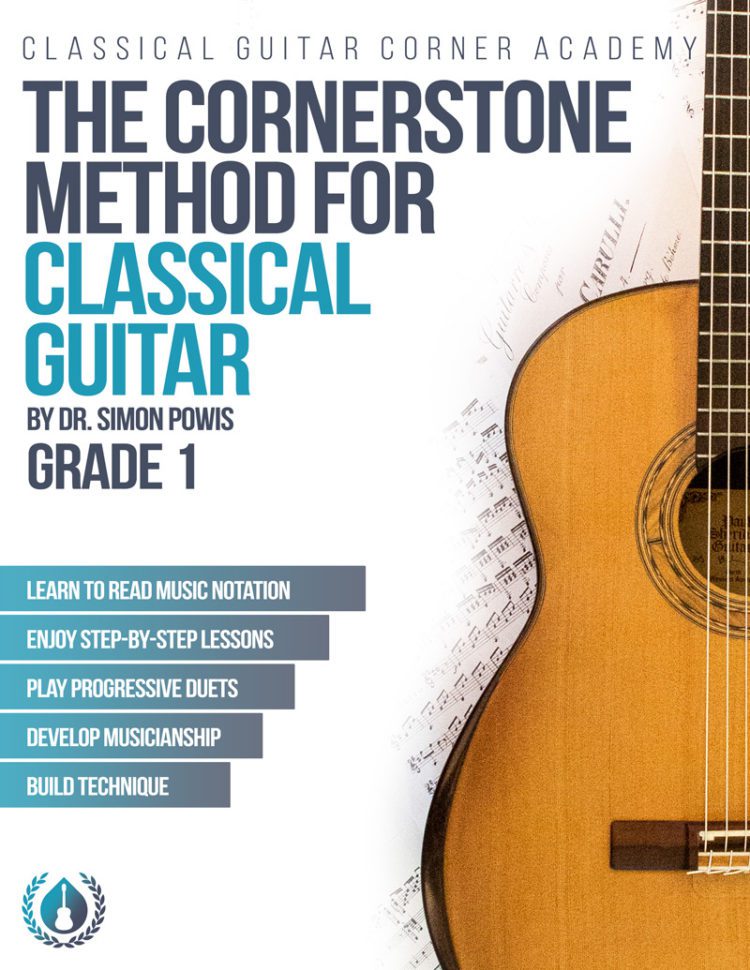
If you’d like to check out what The Cornerstone Method is all about from the start, check out our The Cornerstone Method: Grade 1 book. This beginner guitar method will teach you how to read music, provide progressive technical development, and introduce key musical concepts.
Get your copy of The Cornerstone Method for Classical Guitar: Grade 1 here.
Leave A Comment