
Composer library · 1796 – 1853
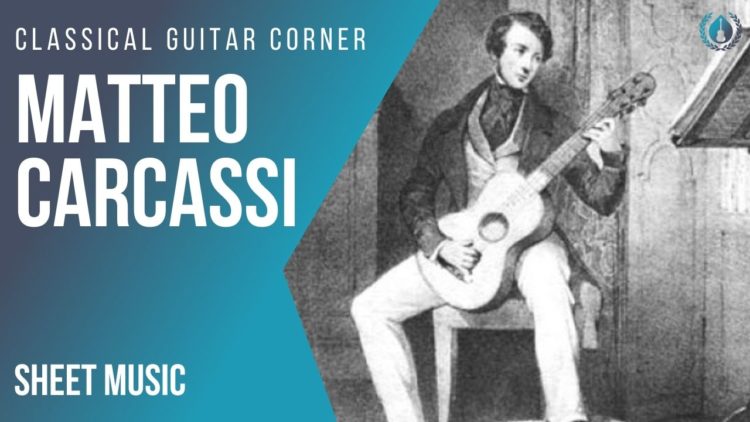
Matteo Carcassi
Sheet music, performances, and resources for classical guitar.
Explore the archive and follow the links to recordings and further learning.
Explore CGC’s teaching
Download · Listen · Learn
Matteo Carcassi sheet music & resources
Download individual PDFs without signing up. Archive editions vary in print quality and fingering; some contain complete sets of pieces.
16 resources · 10 PDFs
3 Rondos, Op.2
Archive score · 10 pages · 1.5 MB
6 Caprices, Op.26
Archive score · 11 pages · 611 KB
6 Valses, Op.4
Archive score · 5 pages · 668 KB
10 Petite Pièces, Op.11
Archive score · 12 pages · 2.6 MB
12 Morceaux Faciles, Op.10
Archive score · 11 pages · 1.4 MB
12 Waltzes, Op.23
Archive score · 8 pages · 1.2 MB
22 Easy and Well-Fingered Pieces, Op.14
Archive score · 14 pages · 1.8 MB
25 Études Mélodiques et Progressives, Op. 60
Archive score · 26 pages · 1.3 MB
Carcassi Etude 16 Lesson
CGC teaching resource
Étude 1 (Allegro)
Video resource
Étude 3 (Andantino)
Video resource
Étude 7 (Allegro)
Video resource
Étude 16 (Andante)
Video resource
Fantaisie sur l'opera "William Tell," Op.36
Archive score · 9 pages · 2.2 MB
Méthode complète pour la guitare, Op. 59
Archive score · 104 pages · 12.7 MB
Prelude by Matteo Carcassi
CGC teaching resource
No matching resources. Try a shorter name or choose “All resources”.
PDFs from CGC’s existing composer archive. Open the backup collection in Google Drive.
Hear the music
Matteo Carcassi, "Allegro," Étude 7, Op.60 (Simon Powis, guitar)
Listen to this selection, then return to the catalogue to explore the available scores and resources.
Back to the resources
The composer behind the music
Matteo Carcassi: biography
Matteo Carcassi (1796 – 1853) was an Italian composer and guitarist who was born in Florence in 1796 and died in Paris in 1853. It appears that he settled in Paris from a relatively young age and it became his new home. In fact, Carcassi even served France as a soldier in the Napoleonic Wars. His first publications, for the solo guitar, were published in the 1820s.
Carcassi’s most important publication, however, was his Méthode complète pour la Guitare (Op. 59) in 1836. In it he announces the publication of “études Op. 60,” which would follow publication after the method. However, it appears this latter book was not published until either shortly before or shortly after Carcassi’s death in 1853. Brian Jeffrey includes a great deal of historical information about Carcassi and his etudes in his Tecla edition of the works.
The French title of the Op.60 set of etudes is 25 Etudes Mélodiques Progressives, or 25 Melodic and Progressive Studies. Thus, each etude is progressively more difficult than the previous. Each etude focuses on a different technical and/or musical element. Some focus on left-hand slurs, others on the barre, still others focus on scales or arpeggios, and some develop musical suspensions or dynamics. The etudes conclude with an exciting virtuosic piece (No. 25) that brings all of these elements together in a showstopper. The contrasting nature of each of the etudes means they work quite well when performed as a collection, but each also stands alone in its own right.
Learn much more about Carcassi’s 25 Etudes, Op.60 in our Composer Showcase here.
Related: Browse the full sheet-music library.
Build your foundation
New to classical guitar?
Start with the free Fundamentals of Classical Guitar course, then explore the repertoire as your skills develop.