
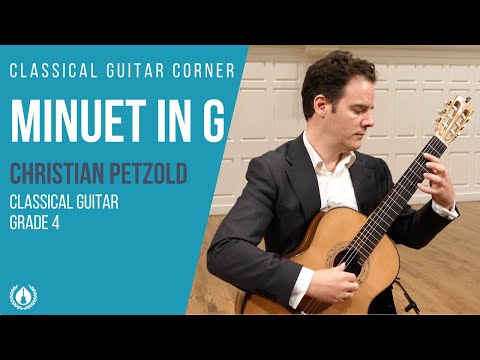
Christian Petzold
Explore the piece
Explore the Minuet in G, its background, and the written guidance for guitarists.
Explore the article ↓Minuet in G by Petzold for Classical Guitar
For generations, the Minuet in G major carried the name of Johann Sebastian Bach. Its real composer was Christian Petzold, a Dresden organist who knew the Bach family well. In our Graded Repertoire for Classical Guitar, it is a Grade 4 piece introducing polyphony in two voices.
Why was the Minuet attributed to Bach?
Well, for years and years it was attributed to J.S. Bach, because it was found in his wife’s keyboard notebook.
Anna Magdalena Bach, Johann Sebastian’s second wife, began this notebook in 1725. She filled it with music for the household: keyboard pieces, songs, and chorales. Many entries are by her husband. Others come from composers in the family’s circle, sometimes copied without a name. Anna Magdalena wrote out two minuets, one in G major and one in G minor, in her own hand. No composer was named, so editors assumed they were Bach’s.
Both minuets entered the Bach-Werke-Verzeichnis, the catalog of Bach’s works, as BWV Anh. 114 and BWV Anh. 115. “Anh.” stands for Anhang, or appendix. This section of the catalog holds doubtful and misattributed works.
How Petzold was identified
In the 1970s, Bach scholar Hans-Joachim Schulze traced both minuets to a harpsichord suite by Petzold. The pieces in Anna Magdalena’s notebook were movements copied from Petzold’s larger suite. The old catalog numbers stayed in place, so many editions still print “BWV Anh. 114” today.
Who was Christian Petzold?
Christian Petzold was born in Königstein, Saxony, in 1677 and died in Dresden in 1733. He was an organist at the Dresden court by 1697. In 1703 he became organist of the Sophienkirche, the Church of St. Sophia in Dresden. From 1709 he also served as court chamber organist and composer.
Petzold was a celebrated organ virtuoso who travelled to perform in Paris in 1714 and in Venice in 1716. He also taught; his students included the composer Carl Heinrich Graun.
His ties to the Bach family ran deep. Bach visited him in Dresden, and Petzold acted as an agent there for Bach’s keyboard Partitas. After Petzold died, Bach’s eldest son, Wilhelm Friedemann Bach, succeeded him as organist at the Sophienkirche.
Only a handful of Petzold’s works survive. For keyboard, they include one harpsichord suite, 25 concertos for solo harpsichord, and 11 fugues. Beyond the keyboard, there are two partitas for solo viola d’amore and the cantata Meine Seufzer, meine Klagen.
The Minuet in G minor and the Suite in G
The Minuet in G major has a companion, the Minuet in G minor (BWV Anh. 115). Both come from Petzold’s harpsichord suite. Players often pair them da capo: the G major minuet, then the G minor, then the G major again. The minor-key minuet works much like the trio section in a later minuet and trio.

The minuet itself began as a French court dance in triple meter, a favorite at the court of Louis XIV. By Petzold’s time it was a standard movement of the keyboard suite. For more on the minuet’s place among the period’s dances, see our guide to Baroque dances and the dance suite.
The Minuet in G minor by Petzold is part of our Graded Duets for Classical Guitar.
A Cornerstone of piano teaching
Generations of piano students have learned the Minuet in G as an early Baroque piece. It features two independent lines: a melody in the right hand and bass in the left. This piece thus serves as a perfect entryway to hand independence, which is the reason teachers keep returning to it.
Why the Minuet in G is great for classical guitar students
On the guitar, the right hand plays both lines. The thumb takes the bass while the fingers play the melody. Meanwhile, the left hand holds notes in both voices at the same time. This makes the Minuet in G a natural bridge into counterpoint, the art of combining independent melodic lines.
The piece is in 3/4 time and in binary form, with two halves that each repeat. Each half is 16 measures long and divides into regular four-measure phrases. These phrases give you clear units to learn one at a time.
Want to learn more about phrasing? Read our blog on How to phrase your music, which features the Minuet in G as an example piece.
Polyphony in two voices
This is a new level of polyphony (meaning “many voices”), and the bass line is almost as active as the melody in this piece. Thus the bass has a melodic shape of its own: it moves in its own rhythm, sometimes stepping while the melody holds a note.
In the Cornerstone Method at Classical Guitar Corner Academy, it sits in Grade 4 alongside Bach’s Largo from the Harpsichord Concerto in F Minor (BWV 1056). Both pieces feature two moving independent lines.
Two-voice playing requires careful listening. Let each bass note ring for its full value while the melody moves above it. Check that melody notes never cut off the bass note beneath it. One useful exercise is to play only the bass line through a phrase and sing the melody above it. Then reverse the roles: play the melody and sing the bass.
Learning the Minuet in G on Classical Guitar
Prepare the Left Hand
Take your time to learn each phrase and aim to develop your left-hand preparation, so that your fingers move smoothly and quickly to their destinations. Preparation means a finger begins moving toward its next note before that note is due. Watch for moments where the bass and melody change together. Both fingers must land at once, so practice placing them as a pair before you play the notes.
Spot Practice the Second Section
The opening of the second section is a good place to apply spot practice. In our Spot Practice on Classical Guitar video, we use this passage of the Minuet to show the method. Spot practice removes tempo from the equation. Stop at the difficult change and plan the movement each finger needs to make. Then place your fingers in a relaxed way, and repeat until the change feels secure. Once it does, bring in slow practice with a metronome and gradually work up to tempo.
Shape the Dance with Articulation
As the Minuet is a dance, you might consider adding some articulation to the 2nd and 3rd beats of some measures such as the second measure or the fourth. Lightly detached notes on those beats give the music a lift, like a dancer rising out of a step.
Feel free to be creative with articulation and dynamics. The repeats are a natural place for variety. You could play a section softer the second time through, or change which notes you detach. You can also add ornaments on the repeat; our guide to ornamentation in the music of J.S. Bach covers the conventions of the period.
Why Learn the Minuet in G?
The Minuet in G is a great piece and brings a whole new set of challenges. It trains you to hear two lines at once, sustain one voice while the other moves, and plan ahead. This makes the Minuet a great transition to a lot of J.S. Bach’s music we play on the guitar.
Ready for more? Explore our guide to J.S. Bach on the guitar.

Graded Repertoire for Classical Guitar: Grades 1-8
The Minuet in G by Petzold appears in our collection Graded Repertoire for Classical Guitar: Grades 1-8. This book gathers 52 works across grades 1–8 in an organized, progressive path through the core classical guitar repertoire. Inside you will find music by Sor, Scarlatti, Bach, Barrios, Tárrega, and many more, all in easy-to-read editions. Over 20 pages of notes and instructions show you what to focus on in each piece. Every score has been carefully edited for clarity and instruction.
You can watch video performances of almost every piece on the Classical Guitar Corner Books page.
Go here to pick up your copy of Graded Repertoire for Classical Guitar.