
Maria Luisa by Sagreras for Classical Guitar
Maria Luisa is a mazurka by the Argentine guitarist and teacher Julio Sagreras. It features a singing melody that jumps across the fingerboard over a dance-like accompaniment. Maria Luisa is a Grade 6 piece in our Graded Repertoire for Classical Guitar.
Who Was Julio Sagreras?
Julio Salvador Sagreras was born in Buenos Aires on November 22, 1879 and died there in 1942. His father, Gaspar Sagreras, was a guitarist and composer, and was Julio’s first teacher. Julio was performing in concerts by the age of six. He went on to study harmony, and by 17 he was teaching advanced harmony courses himself. At 20 he was appointed professor of guitar at the Academia de Bellas Artes in Buenos Aires. In 1905 he opened his own school, the Academia de Guitarra.
Teaching defines the legacy of Sagreras: he wrote a seven-book method consisting of six volumes of Lecciones de Guitarra, followed by the Técnica Superior. The books lay out careful, well-annotated steps so that a student could teach themselves from them. The first three books remain in print today in an English edition, Guitar Lessons, Books 1–3.
He was also a prolific composer. His publisher, Francisco Núñez, issued roughly one hundred of his works.
Where Maria Luisa Sits in Sagreras’s Music
Maria Luisa is the second of Sagreras’s Tres Piezas Fáciles y Progresivas, Op. 19, dated to 1920. The title translates to “Three Easy and Progressive Pieces,” which opens with a Marcia and closes with Nostalgia, with Maria Luisa in the middle.
Sagreras dedicated his Tres Piezas to his “querida hermana,” his beloved sister.
What Is a Mazurka?
The mazurka began as a Polish folk dance of the Mazurs, the people of Mazovia, on the plains around Warsaw. It is in triple time, usually 3/4, with a forceful accent on the second beat. Accents can also fall on the third beat, and phrases often end on an unaccented third beat.
After Poland lost its independence, the dance spread through the ballrooms of Europe, reaching Paris and London in the 1830s. Frédéric Chopin brought it into concert music with around 57 mazurkas for piano. Sagreras wrote several mazurkas of his own, including Dulces Cadenas, Op. 1, which he called a “mazurka de salón,” and Mercedes, Op. 108.
Learning Maria Luisa on Classical Guitar
Let the Dance Set the Tempo
Play Maria Luisa at a moderate tempo that would suit a dance. If you experiment with different tempos, you may find the character changes quite a lot.
The accompaniment shapes the dance feel as much as the melody does. Sagreras writes the basses as quarter notes, so each bass should stop after a single beat. Stopping them takes extra work, but it adds to a clean, articulate sound in the accompaniment that suits the dance.
Some phrases move across the bar line, which needs the same care. When a phrase crosses the bar line, the downbeat note often ends the gesture. Here we can borrow a phrase from David Russell about phrasing: “yes, no.” The strong note is the “yes,” and the resolving note is the “no.” Essentially this means to let the stronger downbeat relax into the resolution with a decrescendo.
Tempo rubato, or stretching time by pushing forward and then holding back, also suits the style. In the first section, the phrase drives toward an E major chord in ninth position. Push the pulse forward through the phrase, then broaden into the arrival.
Traversing the Fingerboard
The opening measure outlines an A minor arpeggio with passing tones. It begins in first position and climbs to fifth. This measure appears four times in the first section, and eight times once you take the repeat. So that makes it an important passage to get right! One thing that will help is to plan out your right-hand fingerings. And a great way to do that is to learn the right hand alone on open strings first. If you start this opening measure with the i finger, it gives you good string crossings. The open first string also gives you a nice, smooth shift from first to fifth position. Don’t forget dynamics: add a crescendo up toward the high C on the first string. This really gives the opening gesture a lot of life.
Some shifts in Maria Luisa travel along a guide finger. That allows a light portamento, a gentle slide between notes. It is a common expressive touch in 19th-century guitar music. Vary how much pressure you add for variety. On the repeats, you can also re-finger the opening arpeggio up in fifth position for a different color. For more on moving around the neck, see our guide to shifting in the left hand.
Bringing Out the Melody
The first section has three voices: melody, bass, and harmonic accompaniment. You can sometimes use a rest stroke (like the high C at the end of the opening gesture) to create separation between the voices. Just be sure to keep the accompanying pairs of notes light. Another technique that can help create separation and voicing is adding left- or right-hand staccato to these middle accompaniment notes.
One of the most beautiful moments in the piece is a high E tied across the bar line at the end of measure 2. The syncopation creates a feeling of hold and release. Give that E its full two beats, and consider adding vibrato to help it sing.
In the second section, the melody moves into the bass register. The best way to bring out the melody is to use a double thumb stroke. The thumb passes through two strings in one quick motion, with more weight on the string with the melody. Practice it on the open A and D strings, aiming for a louder D. There will always be a tiny delay between the two notes, though typically we want to remove as much delay as possible. (In other instances we can accentuate the delay by splitting the two notes and expressively placing the melody note.) You can of course play these notes with thumb and index finger, but the double thumb gives the melody a full, rich sound that suits this section’s weightier character.
The other interesting element of the melody in this bass section is that it splits between two registers, with a lower voice starting each idea and a higher voice completing it. Think of this like a baritone singer whose line is finished by a soprano.
Why Learn Maria Luisa?
Maria Luisa gathers several intermediate skills into one piece: shifting into high positions, rest-stroke melody, thumb melody, articulation, and rubato. Its repeated material means every detail you refine returns many times over. For another mazurka to explore, check out Tárrega’s Mazurka for two guitars.
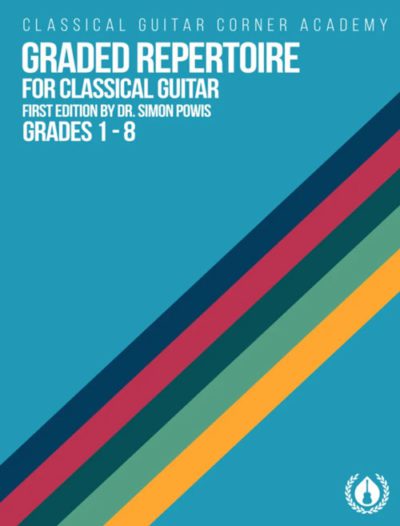
Graded Repertoire for Classical Guitar: Grades 1-8
Maria Luisa by Sagreras comes from our collection Graded Repertoire for Classical Guitar: Grades 1-8. Featuring 52 works that span grades 1–8, this book presents an organized and progressive approach to the core classical guitar repertoire. You’ll find works by Sor, Scarlatti, Bach, Barrios, and Tárrega, and many more, all laid out in easy-to-read editions. With over 20 pages of notes and instructions the book offers guidance to the reader about what to focus on in each piece. The scores have been meticulously edited for clarity and instruction.
You can watch video performances of most all of the pieces on the Classical Guitar Corner Books page.
Go here to pick up your copy of Graded Repertoire for Classical Guitar.
Leave A Comment