
Download the PDF Sheet Music of Gymnopédie No.1 by Erik Satie for classical guitar
Gymnopedie by Satie
History of the Gymnopedies
Erik Satie wrote three compositions that he called “Gymnopédies.” The term itself comes from ancient Greece, specifically in Sparta, where an annual festival called the Gymnopaedia was held each year. The festival featured men of various generations dancing nude together.
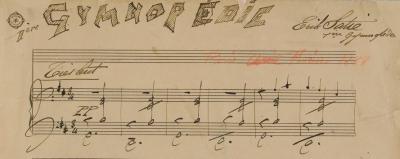 Satie composed the three gymnopedies in 1888, though he did not publish all of them at the same time. Each is in 3/4 time and carries a sense of sadness. The autograph manuscript bears slight differences from the later published versions. For instance, the three movements have the following expression marks in the autograph manuscript:
- Tres lent (Very slow)
- Lent et grave (Slow and grave)
- Lent et grave (Slow and grave)
However, the published editions include these:
- Lent et douloureux (Slow and painful)
- Lent et triste (Slow and sad)
- Lent et grave (Slow and grave)
Gymnopedie No1
The first gymnopedie is in the key of D Major, but flirts with D minor in the middle section. The left hand plays a series of chords preceded by a bass note throughout. These alternating chords lend a sense of relaxed ambience to the music. The lilting melody is played by the right hand. It is never rushed and remains delicate from beginning to end.
There are several dissonances in the melody, especially in the middle section and toward the end, which sets up the turn toward a final D minor chord. This lends a sense of sadness to the calm of the opening major seventh chord.
Gymnopedie No1 for Guitar
Arranging piano music for the guitar requires some compromises. Very rarely can we fit everything from the original to the guitar without alteration. That is certainly true with our arrangement here as well. We have changed the key from D Major to E Major. This allows for the use of many open strings in both sections and makes the piece simply easier to play. We have also reduced or thinned out chords in some places to give priority to the melody.
Gymnopedie No1 Guitar TAB Performance Notes
Rests in accompaniment
In measures 1-5 you’ll notice there are rests in the accompaniment on beat 1. The bass plays on beat 1 and the accompaniment comes in on beat 2. This is the texture of the accompaniment for almost every measure in the piece. For that reason, we have left the rests in the first five measures, but removed them from the rest of the piece to clean up the score. This makes it easier to read. Just know that there is a rest in the middle, accompaniment voice in nearly every measure of the piece.
Barres
There are many barres throughout the piece. Conserve your left-hand energy by releasing from barres when they are not needed. For instance, the first chord is played without a barre, even though it may seem easier to prepare the barre for the second chord here. Instead, save energy by being picky with where you use the barre. We have tried to indicate barres only when they are necessary.
Moreover, be sure to use good barre technique by applying weight with the arm rather than squeezing with the thumb on the back of the neck.
Bass stopping
The first section (measures 1-16) has open bass notes on the fifth and sixth strings throughout. If you let all of those notes ring, not only will the sound be pretty muddy but the harmony will also be less clear. Use a combination of two different kinds of bass stopping to clean up the bass line.
First, use a light rest stroke when playing the sixth-string E. This will silence the ringing fifth-string A and also prepare your thumb on the fifth string for the next bass note.
Secondly, as soon as you play the fifth-string A, reach back with the thumb to touch the ringing sixth-string E. Be sure to touch it with the flesh and not the nail to avoid a “zzz” noise.
Register of voices
One difficulty with bringing piano music to the guitar is that we do not have nearly the range that the piano has. That means some notes will be either too high or too low for us. Or, in other situations, we may already be playing the lowest note on the sixth string and so other lower notes may only work if they are moved up an octave.
In this piece the melody has many leaps and this will mean the accompaniment also tends to leap with the melody. Take measures 16-21. Here we have tried to maintain the original register of the melody (keeping it above the accompaniment) without thinning out the accompaniment too much. There are alternatives to this passage if you wish to stick even closer to the original, or if you don’t mind making the accompaniment move above the melody.
Artificial Harmonics
The harmonic A at measures 37 and 76 should be played as an artificial harmonic on the open fifth string at the twelfth fret. That is, this is a right-hand only harmonic. There is no other way to hold both the bass note and the accompaniment note and also play the A.
Structure
You may notice that measures 40-71 simply repeats the material from measures 1-32. We could have used repeat signs and first and second endings, but take a look again. The dynamics are slightly different the second time through.
Dynamics
This piece tends to dwell in the dynamic range of piano to pianissimo. But notice how specific Satie is with his dynamic markings. Crafting careful phrasing with dynamic shape is what takes this piece from “okay” to “great.” So really spend a lot of time with your dynamics. Work to make them gradual and even at times surprising.
Great to see this new addition to your intermediate lessons!
Simón can we get this music without tab?
Wonderful piece and performance. Some of the voicing are very interesting. The notation and tab do not match on measures 56-57. I personally like the notation fingering but to each his own.