
In this lesson
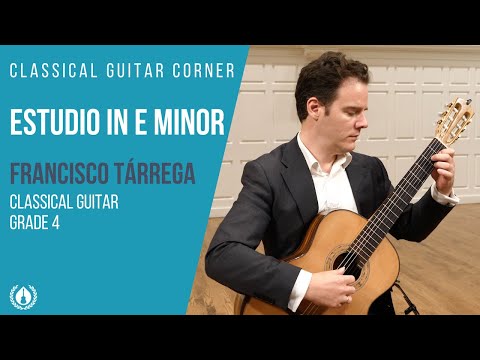
A Family Resemblance
Francisco Tárrega’s “Estudio in E minor” could well be mistaken for the equally popular “Romanza.” Both pieces are in E minor with a soaring first-string melody above a rolling three-note arpeggio.
While Romanza is anonymous, and its origins are still debated, the piece we’ll look at here comes from one of the greatest composers for the classical guitar, Francisco Tárrega. If you love the sound of Romanza, this study offers that same flowing atmosphere but is much more technically manageable.
Tárrega the Teacher
Francisco Tárrega (1852–1909) shaped the classical guitar through his students as much as through his compositions. His pupils included Miguel Llobet, Emilio Pujol, and Daniel Fortea. All three carried his ideas into the twentieth century. Pujol later wrote a guitar method grounded in Tárrega’s teaching, while Llobet toured Europe and the Americas as one of the first great international guitar recitalists.
Tárrega’s Studies
Tárrega published only nineteen works during his lifetime. Most of his studies reached print after his death in 1909, through editions prepared by his students and later editors. Those editions often mixed his own studies with exercises the editors added. As a result, it is not always clear which studies are Tárrega’s own. Karl Scheit’s Universal Edition volume was the first to collect all of the technical studies.
The technical studies are brief exercises for slurs, scales, and arpeggios. Tárrega also wrote fuller studies that build a technique inside a complete piece of music. Among them are the Estudio en Arpegios and the Estudio en forma de Minueto. Others include the Estudio Brillante after Alard and the Estudio sobre una Fuga de Bach. His Recuerdos de la Alhambra takes the same idea further, building a whole concert piece from tremolo.
The Estudio in E minor belongs with these musical studies, and it is one of the most approachable. A single right-hand pattern runs through most of it, and the left hand stays mostly in the lower positions. Some editions add a third section to the piece. It is not known whether Tárrega intended it.
This study develops right-hand arpeggios and introduces new left-hand demands. It also makes useful preparation for Lágrima, which calls for similar barre work and a singing melody.
The arpeggio
The right hand repeats one pattern for most of the piece: a m i, played across the top three strings. The ring finger usually carries the melody on the first string. The middle and index fingers fill in the harmony below.
That repetition makes the arpeggio a perfect candidate for focused practice. Play the a m i pattern on open strings, with no left hand at all. This lets you work on two things at once:
- Balance. The melody note under a should sing above the other two. Give it a slight accent, and keep m and i softer and even.
- Sound. With the left hand out of the picture, you can listen closely to your tone. Check that each finger produces a full, round tone.
Keep the hand itself steady above the strings, and let each finger move from its base knuckle. A stable hand keeps string contact consistent, so every note starts from the same place. And a more consistent point of contact will not only make the arpeggio sound more even but will also give you a better tone.
Practice the open-string pattern with a metronome at first, until it’s very comfortable. Once the pattern is steady and balanced, bring the left hand back in. Then add expression: rubato at the ends of phrases and dynamic shaping across each line.
Making the melody sing
Once the arpeggio feels smooth, turn your attention to the melody. Play only the melody notes with the ring finger, and sing along. Singing is great to get a sense of where a singer might need to take a breath or how a singer may add intensity and vibrato. All of this can give us insight into how to phrase on the guitar. Once your melody is singing, return to the full texture and keep that same shape in mind.
The real challenge here is balance in the right hand. The ring finger has to project the melody while not allowing other fingers in the arpeggio to cry out for attention. Let the a dig in slightly deeper into the string than m and i. This gives the melody more weight without breaking the flow of the pattern.
Keep the bass in its place
The thumb anchors the harmony with long-held bass notes. The bass should sound full and ring underneath the arpeggio. Take care to stop basses from one harmony to the next. When you play an A on the fifth string, for instance, the E on the sixth string (which belongs to a different harmony) should be stopped.
With these three layers well-balanced, you’re left with a singing melody, flowing accompaniment, and a well-defined harmony. But it’s a lot of work for the right hand, so take it one step at a time!
New ground for the left hand
This Estudio introduces two left-hand milestones: the barre, and fifth-position playing.
The Five-string barre
It’s important to recognize that not every barre requires the index finger to cover all the strings. In this piece, for instance, the barre covers only five strings. Moreover, a barre really only needs to press into the strings where a note actually sounds. Lay the index finger flat, then check each string one at a time. If a note buzzes, adjust the angle of the finger or bring the elbow slightly in. Release pressure the moment the barre is no longer needed, to keep the hand relaxed.
Up to fifth position
In measure 9, you have a shift into fifth position. Prepare the shift in advance by looking at the destination fret before you move. Keep the thumb relaxed behind the neck so the hand can travel freely. Practice the shift slowly in isolation and then add it back to the whole phrase once it’s comfortable.
Where It Leads
The Estudio is one of several pieces by Tárrega in our Graded Repertoire for Classical Guitar. Once it feels comfortable, explore Romanza and Lágrima next (a shared musical language runs through all three). More advanced players may be ready to tackle Capricho Árabe. For more context on the Spanish tradition, visit our page on legendary Spanish guitar players.