
In this lesson
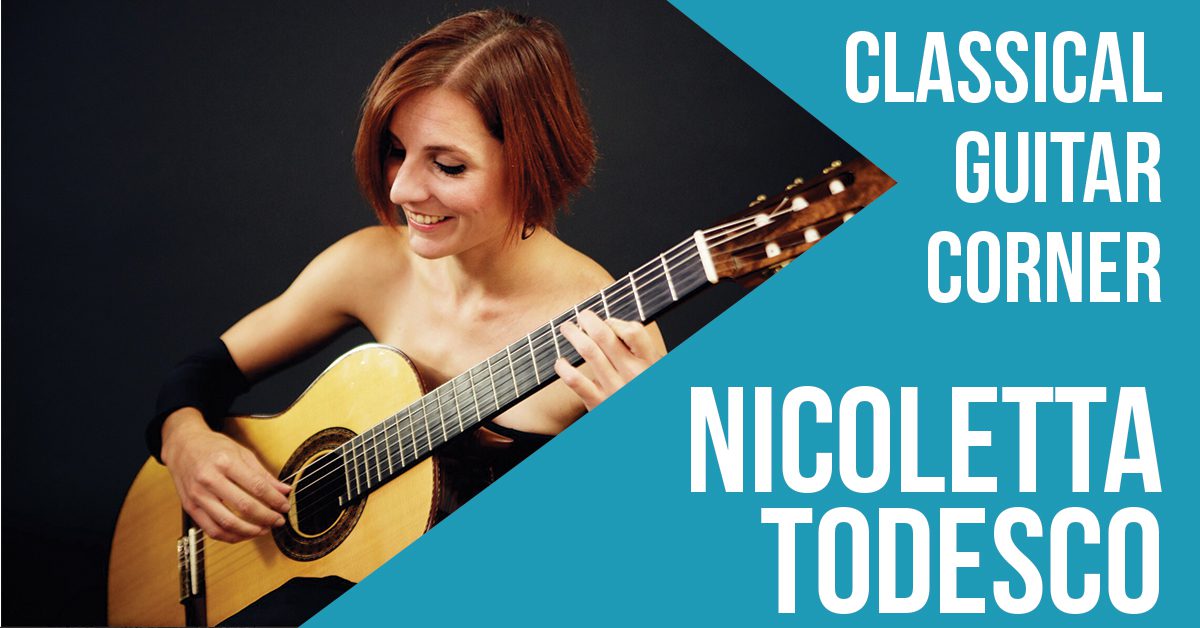
Nicoletta Todesco shares the path from a small music school in northern Italy to conservatory study, musicology and Yale. The conversation with Simon Powis also explores how she developed as a teacher and found room for singing within her classical-guitar performances.
The recording opens with Simon’s separate reflections on inclusion and representation in the guitar community. The interview begins around ten minutes in. These notes focus on Todesco’s experiences and the questions about education that grow from them.
Podcast: Play in new window | Download
Subscribe: Apple Podcasts | RSS
Originally published in 2020. These listening notes draw on the recorded conversation. Roles, projects, releases and event announcements refer to the time of recording. Practical reflections are suggested applications, not additional quotations from the guest.
Explore the conversation
Use these approximate timestamps to jump to a topic in the recording.
- 18:05 — A first teacher can make performing feel part of learning
- 26:22 — Finding an artistic voice can mean reconnecting parts of your life
- 33:14 — Choosing repertoire means designing a path for this student
- 34:04 — Being able to play something is different from explaining it
- 38:22 — Online teaching makes communication especially important
- 14:00 — Knowing the person behind the lesson strengthens community
A first teacher can make performing feel part of learning
Todesco recalls choosing guitar because her family already had an instrument when a local music school opened. Her teacher created small concerts and opportunities to play from the beginning, helping turn an afternoon activity into a lasting interest.
Later conservatory study brought discipline and a demanding sequence of requirements. She is grateful for what she learned while also recognising things she would approach differently as a teacher. Subsequent study exposed her to other ways of thinking about music.
The useful thread is that an educational path can provide both valuable skills and assumptions worth revisiting. Understanding how you were taught is a starting point for choosing what helps the next learner.
Finding an artistic voice can mean reconnecting parts of your life
“the moments to remember more than everything else.”
— Nicoletta Todesco, 28:01
Todesco had sung in other settings before considering singing within a classical-guitar recital. At Yale, Ben Verdery encouraged her to explore that interest rather than regard it as something outside her identity as a guitarist.
The permission to try mattered. A personal musical interest became something she could develop and share within a concert. The story offers a different picture of advanced study from simply making an existing style more polished.
She also recalls an informal musical encounter with Berta Rojas at Summer School. Its importance was the pleasure of sharing songs with a musician she admired. The experience did not depend on a large stage or a formal achievement.
Choosing repertoire means designing a path for this student
Asked what she would change about her early teaching, Todesco first points to repertoire. Initially she relied heavily on the route she had followed herself. Experience helped her assemble a broader set of choices for different students.
She identifies a particular challenge in connecting accessible beginner material with the established classical-guitar repertoire. One method book may provide a good beginning without supplying every useful step afterwards.
A teacher’s work includes building those connections. For a student, this is a reason to discuss both what you enjoy and what you are learning from a piece. An appealing choice can still have a clear educational purpose.
Being able to play something is different from explaining it
“I knew how to do it, but not how to explain it.”
— Nicoletta Todesco, 34:34
Todesco describes becoming more precise about how movements work and how to communicate them. Demonstration alone had not always explained what a student needed to understand.
This distinction runs through the discussion of teaching. A performer can possess considerable skill while still needing to learn how to break a task into understandable parts, notice a student’s response and choose another explanation.
For learners, an unclear explanation is an opportunity to ask a more specific question. Describe what you tried and what happened. That feedback helps the teacher decide whether a verbal description, an image or another demonstration would be more useful.
Online teaching makes communication especially important
Todesco describes learning to allow for delay, wait for a student to finish and organise explanations more deliberately online. Physical details that are easy to demonstrate in person may need another approach on a screen.
The conversation also considers differences between teaching children and adults. She emphasises involving children in activity and adapting the way an idea is presented. The discussion is exploratory; it does not establish fixed psychological types or a universal learning-style system.
The common principle is to notice the person’s response. If an explanation does not connect, repeating it more insistently may be less useful than finding another way to express the same musical task.
Knowing the person behind the lesson strengthens community
Early in the interview, Todesco reflects on how members responded differently once they had heard her story and seen her on a livestream. An administrative name became a recognisable musician and person.
That connection sits alongside the practical teaching discussion. People are more than the particular difficulty they bring to a lesson, and a musical community grows through ordinary exchanges as well as formal instruction.
For an online learner, introducing yourself, sharing a musical interest and responding thoughtfully to another player can help build that connection. Participation gives the lessons a human context.
Ideas to take into your own music
These prompts are reflections on the conversation, rather than a routine prescribed by the guest.
- Revisit your repertoire path: ask what each piece teaches and how it connects to the next.
- Ask for another explanation: describe what you tried when an instruction is unclear.
- Give an artistic interest room: explore a song or style that matters to you.
- Contribute to the community: share an observation or a musical question with another learner.
Original episode notes and resources
The original introduction and resources are retained below. Any time-sensitive announcements belong to the episode’s publication period.
In the latest episode of The Classical Guitar Corner Podcast Simon interviews our very own Nicoletta (Niki) Todesco! Please tune in to hear all about Niki’s background with the guitar, teaching, and performing as we celebrate her one-year anniversary on the CGC Team! Be sure to leave a comment to join the conversation!
Connect with Niki on her website.
This was a fantastic podcast. I haven’t had the pleasure of meeting Niki yet, and this was a wonderful introduction. I’m looking forward to get acquainted when the opportunity arises in CGC.
Hello,
Thank you for the introductory conversation concerning Black Lives Matter. Simon, your meaningful introspection on the many aspects of social justice is important. We need to care. Listening to the conversation with Nicoletta is a joy. Thank you for your open enthusiasm. Musical education is a journey as Niki sensitively expresses—Niki’s passion is an inspiration! As instructors attention to individual styles is a way to help students grow naturally. Artistic ideas develop in openly conversant learning environments. Nice work!
Cordially,
Drew
Niki is such a bundle of energy and fun. Great interview!
Niki is such a wonderful addition to the CGC staff! It’s a joy to have her on coaching calls, at open mic sessions and in so much more. Thank you for talking with her in depth in this podcast.
Thank you, too , for your opening words on the very important and current topic of discrimination. I have always found CGC to be an extremely open and welcoming place for lovers of classical guitar from all over the world.
I think that there is nothing better to climb the journey of success
as competence. The level of competence among women has
skyrocketed and as a result there are so many women that are
shining bright with talent and are having an impact.
Of course technology has had a liberating effect also.
I’m delighted by the diversity of guitarists I see on the internet.
I’m blown away by the talent our there.
I always believed music to be a universal language. Breaking down all barriers, colored blind.